
🔹 Why a Dynamic Strategy Map?
A Living Framework for Adaptive Strategy
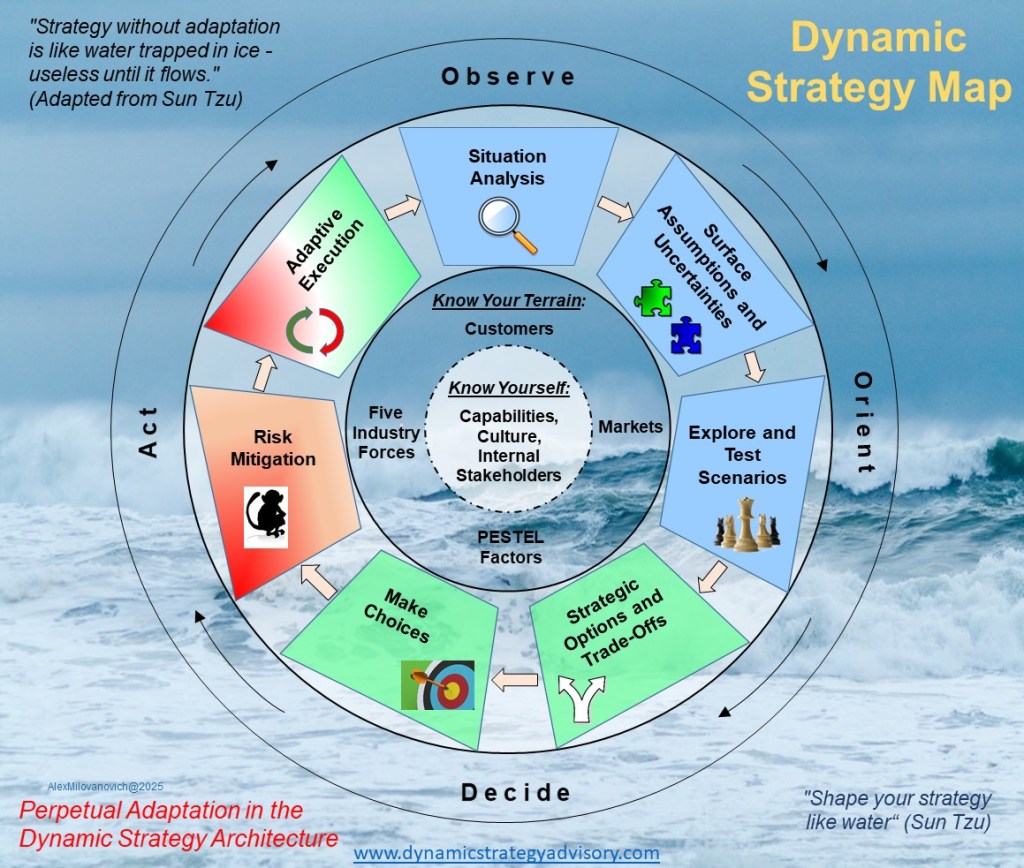
In a world where disruption is constant and uncertainty is the norm, traditional strategy tools fall short. The Dynamic Strategy Map offers a novel approach – one that integrates continuous adaptation and real-time feedback into the heart of strategic thinking.
🧭 Designing Principles & Benefits
| Principle | Benefit |
| Continuous Sensing | Stay ahead of change with real-time awareness of trends and signals. |
| Feedback Loops | Learn and adapt faster through structured reflection and iteration. |
| Scenario-Driven Decision Making | Prepare for multiple futures, not just one forecast. |
| Strategic Optionality | Build flexibility into your choices and resource allocation. |
| Resilience & Responsiveness | Thrive under pressure, not just survive. |
The 7-Step Dynamic Strategy Process
Each step is designed to build clarity, challenge assumptions, and support adaptive execution.
1. Situation Analysis
Diagnose your internal capabilities and external environment.
- Customer-Centricity: Place customer needs at the heart of your strategic thinking.
- Stakeholder Insights: Focus on key stakeholder needs, categorizing insights into “hard facts” (data) and “soft signals” (weak trends). Utilize stakeholder mapping.
- PESTLE Analysis: Systematically examine Political, Economic, Sociocultural, Technological, Legal, and Environmental factors.
2. Surface Key Assumptions & Uncertainties
Identify and rigorously test critical assumptions, distinguishing between strong beliefs and potential blind spots.
- Red Teaming: Actively challenge the resilience and logic of assumptions by adopting an adversarial perspective to expose vulnerabilities.
- Assumption Mapping: Visually map assumptions based on their impact and uncertainty.
- Systems Thinking: Adopt a holistic view, inspired by approaches like Amazon’s “Day 1” philosophy, to understand interconnectedness.
3. Explore & Test Scenarios
Develop 3-4 plausible future scenarios (beyond just best/worst-case) and simulate how your market might react within each.
- War-Gaming: Stress-test strategic options against each scenario through simulated competitive interactions.
- Scenario Planning Matrix: Use structured tools to define and analyze each plausible future.
4. Develop Strategic Options & Trade-offs
Generate a diverse set of strategic options, then rigorously evaluate and prioritize them based on clear criteria.
- Prioritization Criteria:
- Value Creation Potential: For all stakeholders and shareholders.
- Feasibility: Assess resource availability, capability alignment, and implementation challenges.
- Risk & Return: Evaluate potential risks and rewards, potentially adjusting for probability of success and downside exposure.
- Resilience: Ability to adapt under uncertainty.
- Differentiation: Uniqueness and competitive advantage in the market.
- Time to Impact: Understand the short-term versus long-term effects.
- Strategic Fit: Alignment with your vision, organizational DNA, and core capabilities.
5. Make Strategic Choices & Define Intent
Select the most promising strategic path(s) and clearly articulate your strategic intent.
- Pre-Mortems: Imagine future failure scenarios to identify potential issues before execution.
- Tripwires: Define specific metrics or events that would trigger a re-evaluation of current decisions.
6. Identify Risks & Mitigation Plans
Proactively map potential risks and develop robust resilience strategies to counter them.
- Build Robustness: Implement intentional disruptions and stress tests, similar to Netflix’s Chaos Monkey.
- Risk Matrix: Utilize a matrix to visualize and prioritize risks based on likelihood and impact.
7. Adaptive Execution
Maintain maximum flexibility throughout implementation with continuous feedback and iterative learning.
- Feedback Loops: Implement “After-Action Reviews” (AARs) post-key decisions to capture lessons learned. Adopt dynamic dashboards for real-time insights.
- OKRs for Adaptability: Use Objectives & Key Results (OKRs) to measure responsiveness (e.g., decision speed, pivot time).
- Iterative Learning: Employ frameworks like the OODA Loop (Observe, Orient, Decide, Act) to foster rapid learning and adaptation.
📘 Want to Go Deeper?
Discover the full methodology behind the Dynamic Strategy Map in my article published by The European Business Review.
