
A strategy is only as strong as its ability to survive contact with reality.
Why Evaluate

Not all strategies are created equal – and not all well-formulated strategies are fundamentally sound.
Organizations often blame strategic failure on poor execution. Yet many execution failures originate much earlier: the strategy itself was unsound before execution even began.
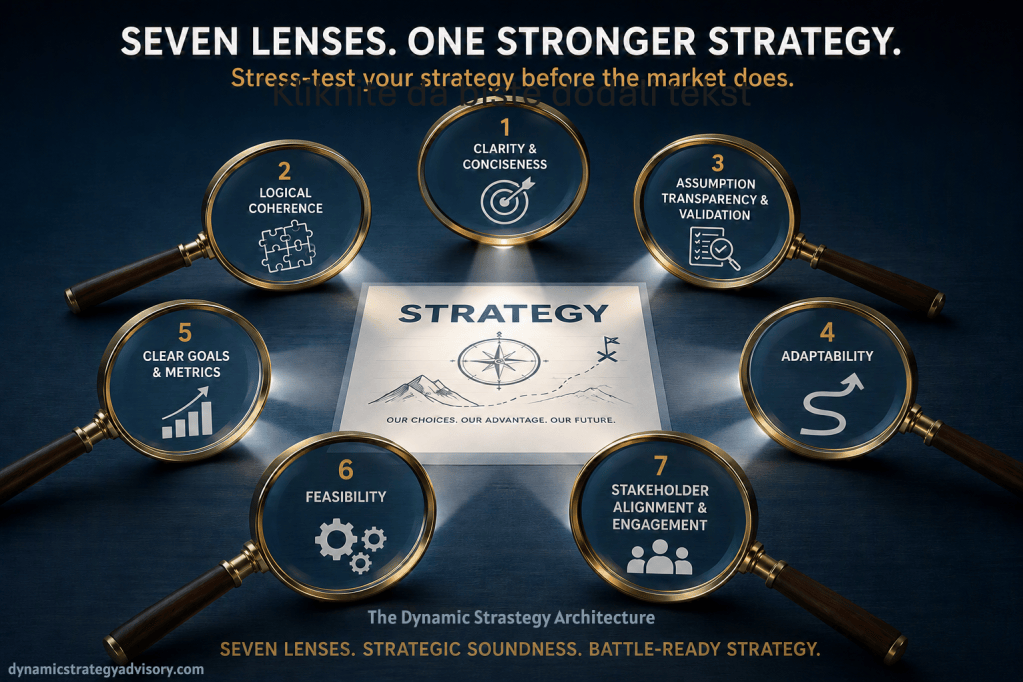
Before committing resources, reputations, and capital, leaders should rigorously evaluate whether their strategy can withstand contact with reality. The Seven-Lens Stress Test provides a practical framework for doing exactly that. It helps leadership teams identify hidden weaknesses while they are still inexpensive to fix, reducing the risk of self-inflicted failure and strengthening strategic resilience in uncertain environments.
🧠 The 7 Evaluation Lenses

1. Clarity & Simplicity
Is the strategy easy to understand, communicate, and act upon?
A clear strategy avoids ambiguity and bloated complexity. It can be succinctly explained to teams, stakeholders, and partners in a few clear sentences. Simplicity means the choices reinforce one another rather than scatter energy.
2. Logical Coherence
Does the strategy follow a clear, logical structure with explicit trade-offs?
Effective strategies create a clear line of sight from strategic intent to concrete actions and expected outcomes. There must be a seamless bridge between ambition and execution, ensuring initiatives flow logically from objectives. When everything is a priority, nothing is, and conflicting commitments erode credibility.
3. Assumption Transparency & Validation
Are key assumptions explicit and valid?
Every strategy rests on assumptions – about customers, competitors, markets, or technology. The question is whether those assumptions are explicit or hidden. A sound strategy identifies the critical ones clearly and establishes ways to test them. Hidden assumptions are blind spots. Explicit ones can be managed, tested, and adjusted as conditions change.
4. Adaptability
Can the strategy adjust if assumptions prove wrong?
The most resilient strategies are built for dynamic environments. They incorporate flexibility, contingency thinking, and feedback loops so that the organization can pivot effectively when reality shifts.
5. Clear Goals & Metrics
What does success look like – and how will we measure it?
Well-defined goals translate high-level strategy into focused action. Whether quantitative or qualitative, they must serve as an operational compass for teams and a reliable benchmark for accountability across defined time horizons.
6. Execution Feasibility
Can the organization realistically execute this strategy?
Even a brilliant strategy will fail if the organization lacks the readiness to deliver it. Execution feasibility asks whether the required resources, capabilities, systems, leadership behaviors, and cultural norms exist – or can be built in time – without derailing execution. It is about aligning ambition with organizational reality.
7. Executive Alignment & Ownership
IIs the executive leadership team aligned, committed, and accountable for executing the strategy?
Successful implementation depends on the active commitment of the leadership team. A sound strategy requires moving past polite consensus and silent nods to ensure every key leader fully understands and owns their role in driving value creation.
🧭 Final Thought
The Seven-Lens Stress Test is not designed to predict success. Markets remain unpredictable. Its purpose is to expose strategic weaknesses before execution begins – when they are still inexpensive to address.
The framework works best as part of a structured Strategy Soundness Workshop, where leadership teams rigorously challenge their own strategy before it is funded, communicated, or executed. The objective is not to eliminate uncertainty, but to ensure the strategy is fundamentally sound before asking the organization to deliver it.
📘 Ready to Stress-Test Your Strategy?
The complete framework, real-world case studies, step-by-step workshop guidance, and a practical 21-question checklist are available in my article published by California Management Review Insights. Use it to catch strategic flaws before they consume resources and reputations.
