In volatility, execution isn’t just implementation – it’s continuous adaptation.
💡 From Strategic Intent to Strategic Impact
A dynamic strategy is only as powerful as its execution.
In today’s VUCA world, traditional execution models lack the responsiveness and agility needed to succeed. That’s why Dynamic Strategy Leadership demands a new kind of capability – one built on adaptive execution, continuous sensing, and real-time learning.
Effective strategy execution is a discipline of alignment and adaptability: aligning activities, resources, culture, systems, and people with strategic goals, while adapting to unpredictable conditions with speed and insight.
🧭 The Role of Leadership in Execution
Strategy execution is not a handoff – it’s a leadership imperative and the vital bridge between foresight and tangible impact. It’s about building and maintaining a competitive advantage by continuously sensing, learning, and adapting. This requires Executive Leadership to actively design, build, and integrate a set of essential competencies, aligning an organization’s resources, actions, culture, and people with its strategic goals.
🧩 The Strategy Execution Engine – A System of Competencies in Motion
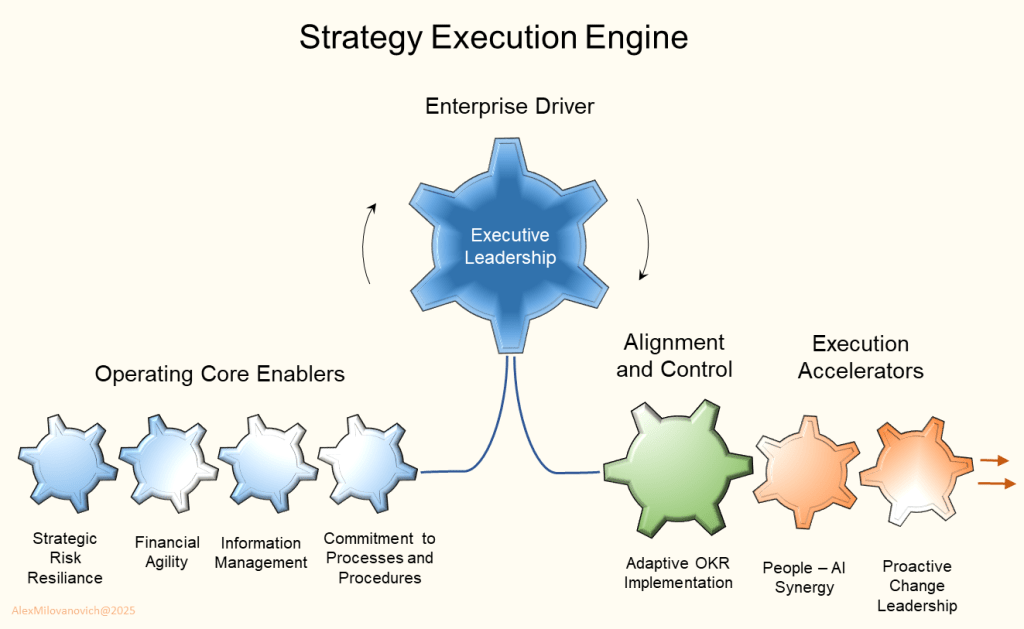
To build agility and impact into strategic execution, organizations must continuously invest in eight interconnected competencies. These ensure not just operational excellence, but strategic adaptability at every level.
I Enterprise Driver
At the heart of the system is Executive Leadership – the primary force that sets direction, drives accountability, and energizes the entire execution effort. It is the central competency that activates and sustains the rest.
II Operating Core Enablers
These four competencies form the foundation upon which execution rests:
- Commitment to Processes and Procedures
- Information Management
- Financial Agility
- Strategic Risk Resilience
Together, they build the organizational infrastructure needed to support strategic adaptability and operational excellence.
III Alignment & Control
This set contains a single but pivotal competency:
- Adaptive OKR Implementation
It ensures that all components of the system remain synchronized with strategic goals, adapting in real time to changing conditions and feedback.
IV Execution Accelerators
These two competencies energize and deliver outcomes:
- People–AI Synergy
- Proactive Change Leadership
They represent the direct actions and behaviors that translate strategy into reality, enabling organizations to move with speed, clarity, and resilience.
This Strategy Execution Engine is not a static model – it is a living system. Its power lies in its coherence, adaptability, and the ability of leaders to orchestrate its movement. The objective is not to perfect each competency in isolation but to cultivate a cohesive, adaptive whole – one in which leadership continuously drives, aligns, and energizes the engine. In the chapters ahead, we will explore each competency in depth, revealing how organizations can build the execution muscle required to deliver on their strategic promise.
→ To dive deeper check out my article “Mastering Execution in the Age of AI and Uncertainty: How 8 Interconnected Competencies Turn Ambition into Reality”.
🌐 Execution in a Dynamic World
When organizations build and integrate these competencies, strategy becomes adaptive, resilient, and impactful – not just on paper, but in practice. Execution is no longer a final phase. It’s a continuous capability – one that distinguishes strategy leaders from strategy laggards.