
Introducing the Dynamic Strategy Architecture – an integrated approach for navigating complexity, AI disruption, and continuous change
The Architecture of Strategy is Broken
Decades of strategy frameworks were built for a different world – one of periodic disruption, punctuated by planning cycles that gave organizations time to think, decide, and then execute in relative peace. That world is gone. AI-driven change, compressed decision windows, and permanent volatility have made disruption continuous rather than occasional. And that shift exposes something deeper than an outdated framework or two: the architecture of how strategy gets built – not merely its content – has become the point of failure.
This isn’t a failure of quality. Today’s strategy frameworks are, individually, valuable. The problem is fragmentation, and a specific kind of it: an inability to sense and respond to signals in time. Formulation gets solved brilliantly by one methodology, culture by another, execution by a third, risk by a fourth – each treated as someone else’s problem, to be handed off later, to a different team, on a different timeline. The cost isn’t abstract. It shows up as transformations that stall halfway, strategies that drift out of alignment with the culture meant to carry them, and capital committed to plans that were obsolete before they finished rolling out.
Patching one more piece won’t fix a fragmented system. The answer isn’t a better tool, and it isn’t a smarter methodology bolted onto the old sequence. It’s a new architecture for strategy itself – one built not as a periodic exercise repeated every planning cycle, but as a living system, designed from the ground up to remain relevant when the world refuses to hold still.
Architecture for a World That Won’t Stand Still
If strategy is to remain relevant in an age of continuous change and accelerating complexity, its architecture must accomplish four objectives. It must rest on foundations that reflect the defining challenges of our era. It must follow a clear, comprehensive formulation logic that brings culture and execution alongside traditional strategy. It must pre-mortem that formulation for soundness before any commitment is made. And it must assure perpetual adaptation – not as an afterthought, but as a design principle.
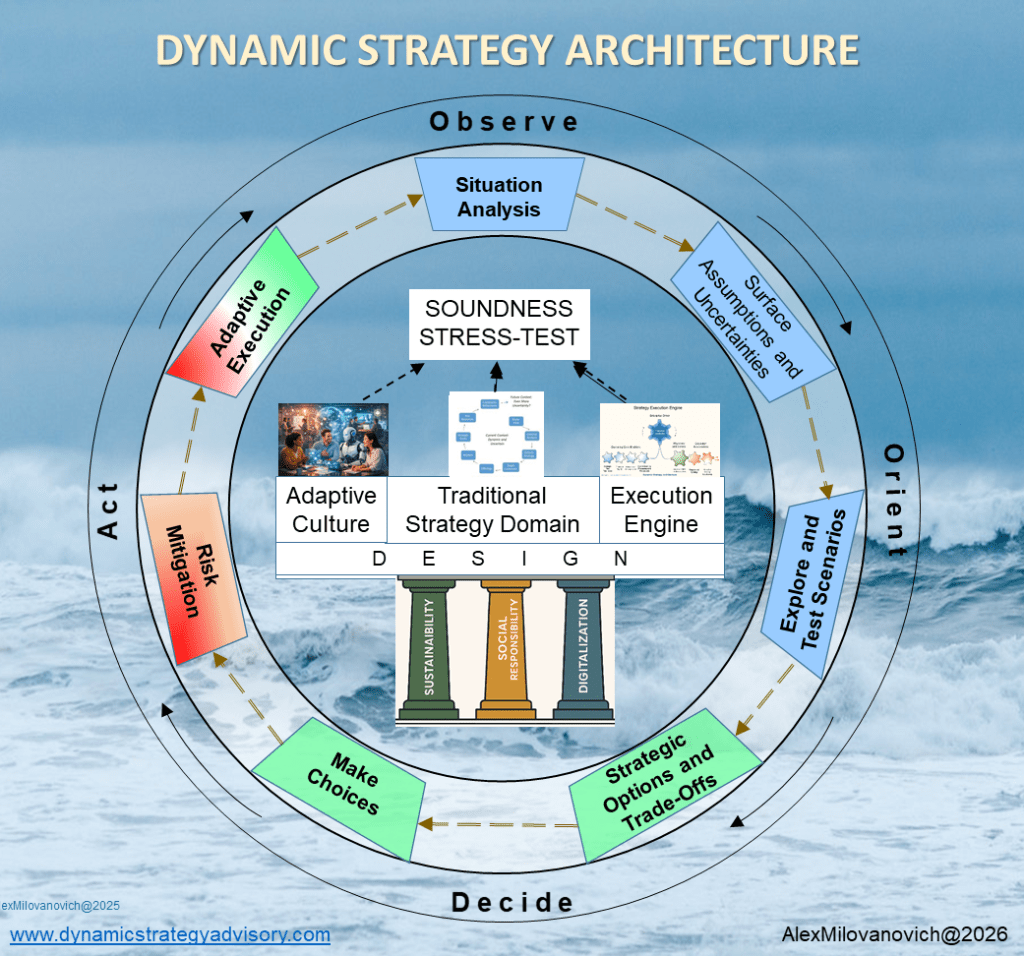
The Dynamic Strategy Architecture was built to meet these requirements. It is not a collection of tools. It is an integrated structure of six interconnected frameworks, designed to work as one coherent whole rather than a sequence of disconnected activities. But before we examine what makes it different, let us first understand how it is organized.
The Dynamic Strategy Architecture (DSA) begins by establishing a new bedrock. We should anchor every strategy on three foundational pillars: Sustainability, Social Responsibility, and Digitalization. These are no longer peripheral concerns; they are the modern-day boundaries of relevance. By integrating these pillars from the outset, we ensure that strategy is not only commercially sound but also legitimate and resilient in the face of today’s environmental, social, and technological realities.
Once the foundation is set, we arrive at the core: the Strategy Formulation Trinity. Traditional frameworks formulate strategy in isolation, treating culture and execution as implementation concerns to be addressed later. The DSA does the opposite. It designs three domains simultaneously: the traditional strategy domain – know-how, understanding customers, external realities, strategic choices, offerings, markets, goals, and resources – alongside adaptive Culture (Psychological Safety 2.0, Learning Velocity, Purpose Anchors, Networked Leadership, and Human-AI Synergy) and the Execution Engine (Executive Leadership, Commitment to Processes, Information Management, Financial Agility, Strategic Risk Resilience, Adaptive OKRs, People-AI Synergy, and Proactive Change Leadership). The result is a strategy that already carries the cultural DNA and execution capability it needs to execute from day one.
Yet, even the most integrated strategy carries inherent risks. This is why the third objective of the DSA is Strategy Soundness. Before a single resource is committed or a reputation is staked, every strategy undergoes a seven-lens pre-mortem stress test organized around four complementary prisms. The Logic of Choice validates clarity and coherence; the Reality Check challenges underlying assumptions and adaptability; the Engine Room tests goals, metrics, and execution feasibility; and the Human Seal ensures deep executive alignment and ownership. This safeguard ensures resilience is built into the strategy before it ever reaches implementation.
Finally, the architecture must provide perpetual adaptation – the quality that keeps strategy in motion rather than letting it harden into a fixed document. This is the role of the Dynamic Strategy Map. By continuously analyzing the situation, surfacing assumptions and uncertainties, exploring alternative futures, evaluating strategic options and trade-offs, making strategic choices, identifying risks and mitigation plans, and steering adaptive execution, the Map keeps strategy connected to a reality that never stands still. Rather than waiting for the next planning cycle, the organization continuously learns, adjusts, and renews its strategic direction as circumstances evolve.
The Dynamic Strategy Map is the most visible driver of adaptation, but it is not its only source. Dynamism is woven into the DNA of the entire architecture. The traditional strategy formulation domain ends with Continuous Refinement – a step that forces organizations to ask how they will monitor, evaluate, and pivot as circumstances change. The Adaptive Culture’s pillars – Learning Velocity, Networked Leadership, and Human‑AI Synergy – enable organizations to sense change early, learn rapidly, make decentralized yet aligned decisions, and adapt continuously. In doing so, they create the conditions for innovation to emerge, scale, and become a sustained competitive advantage. At the same time, the Execution Engine’s competencies keep alignment fluid through Adaptive OKRs, enable rapid pivots under uncertainty through Risk Resilience and Financial Agility, unlock new insights through People-AI Synergy, and foster real‑time evolution through Proactive Change Leadership. It is no coincidence that both Culture and Execution converge on Human-AI collaboration – the AI era demands it as both a cultural and execution capability.
The result is an architecture where dynamism is not an add-on but a design principle. Strategy is built to move, adjust, and evolve – because in a world that refuses to stand still, neither can strategy.
Three Shifts That Change Everything
Three shifts distinguish this architecture from conventional approaches – not by doing familiar things better, but by refusing to let strategy’s critical elements be developed separately, validated too late, and left to decay as the world changes.
The first shift: the traditional strategy domain, culture, and execution designed together. Conventional practice assigns the traditional strategy domain to strategists, culture to HR, and execution to operations – three teams, three timelines, and an assumption they will eventually align. They rarely do, because a brilliant strategy is only as good as the organization’s capacity to carry it out, and that capacity is rarely treated as a strategic variable in its own right. Strategy is implemented by people, and a lack of executive alignment or an absence of psychological safety will quietly undermine even the most rigorous strategy. The Trinity closes that gap at the source: culture and execution aren’t handed a finished strategy to catch up to – they’re designed inside the same step that produces it.
The second shift: soundness earned, not assumed. Most frameworks treat conviction and optimism as sufficient license to proceed. The Seven-Lens Stress-Test treats it as a hypothesis still to be challenged. Before any effort, resource, or reputation is committed, the strategy is interrogated for its assumptions, its adaptability, its feasibility, its alignment – continuously, not as a one-time gate. What survives isn’t a strategy that sounded convincing in the room. It’s one that has already been argued with.
The third shift: dynamism, accelerated by AI. The previous chapter showed that adaptability is built into every layer of this architecture, not delegated to a single component. AI is what lets that built-in adaptability move at the speed the era demands – sharpening environmental sensing, stress-testing assumptions faster, widening the field of strategic options, and tightening execution monitoring, all in real time. But acceleration is not judgment. AI handles the data; the leader handles what it means. AI generates options; the leader decides which ones are worth the organization’s values, ethics, and trust. The architecture doesn’t ask AI to replace strategic judgment – it asks AI to make better judgment possible, faster.
Strategy as a Living System
Traditional strategy assumed stability. Modern strategy assumes adaptation. That single shift changes what competitive advantage even means: it no longer comes from choosing the perfect strategy, but from building an architecture that keeps strategy perpetually relevant as the ground beneath it keeps moving.
Organizations that continue relying on disconnected tools won’t necessarily choose the wrong strategy. They’ll simply watch a reasonable one go obsolete faster than it can be redesigned – not from a bad decision, but from an architecture never built to keep pace with the world it was meant to navigate.
The Dynamic Strategy Architecture offers a different path. Not a better framework, but a better way to build strategies: continuously, rigorously, and adaptively. It does not promise certainty. It promises something more valuable: the capability to navigate uncertainty without losing coherence, to adapt without discarding what works, and to evolve without waiting for permission.
In a world that refuses to stand still, strategy cannot be an artifact. It has to become what we set out to build: a continuous living system.
