
The contemporary world is witnessing an unprecedented convergence of challenges and opportunities. Mounting climate crises, worsening pollution, declining middle-class purchasing power, growing social inequality, persistent poverty, and global health crises threaten the fabric of societies and ecosystems. Economic instability, geopolitical fragmentation, and migration complexities further amplify uncertainty, shaping the landscape in which organizations operate. Stakeholders – from customers to regulators – are increasingly demanding corporate accountability for environmental and social impacts. Yet, many organizations continue to rely on strategies that fall short of addressing these pressing realities.
Simultaneously, rapid advancements in digitalization and Artificial Intelligence (AI) have introduced transformative potential, reshaping industries and redefining the principles of competitiveness. In an increasingly digital world, the failure to integrate digital transformation and AI into strategic frameworks exposes organizations to significant competitive disadvantages.
This article seeks to explore the imperative of crafting strategic frameworks that comprehensively address the pressing social, environmental, and technological challenges of the 21st century. It emphasizes the necessity of grounding strategies in a profound understanding of these prevailing issues, illustrating how organizations can navigate this complex landscape to ensure relevance, resilience, and sustainable growth.
CRAFTING STRATEGIC INTENT IN A DYNAMIC WORLD
The journey of any organization begins with fundamental choices – choices that define its very essence and chart its long-term course. These choices, encompassing what we traditionally call purpose, mission, and vision, are the bedrock upon which all strategic endeavors are built. However, in today’s relentlessly evolving landscape, these foundational elements cannot exist in a vacuum. They must be constantly tested and refined against the crucible of contemporary realities.
The imperative for organizations to revisit and recalibrate their strategic frameworks has never been more urgent. To remain relevant and effective, a deep understanding of emerging challenges, evolving trends, and the complexities of our time is non-negotiable. The days of static, internally focused strategies are long gone.
The contemporary business environment demands a new paradigm – one that seamlessly merges internal aspirations with external imperatives. We must move beyond rigid, siloed approaches and embrace inclusive strategic frameworks. These frameworks must strike a delicate balance between the enduring intent expressed through core choices and the agility required to navigate a world of constant change. This is not simply about adjusting to external pressures; it’s about embedding adaptability into the very DNA of the organization, ensuring that long-term vision and real-time responsiveness are inextricably linked.
FORGING A RESILIENT FUTURE: THE THREE PILLARS OF STRATEGIC TRANSFORMATION
The 21st-century business environment is defined by accelerating social inequality, environmental degradation, and technological disruption. Organizations must navigate a world where the lines between economic performance, social impact, and digital capability are increasingly intertwined. Traditional, profit-centric strategies no longer suffice – thriving in today’s complex reality requires a broader, more adaptive foundation.
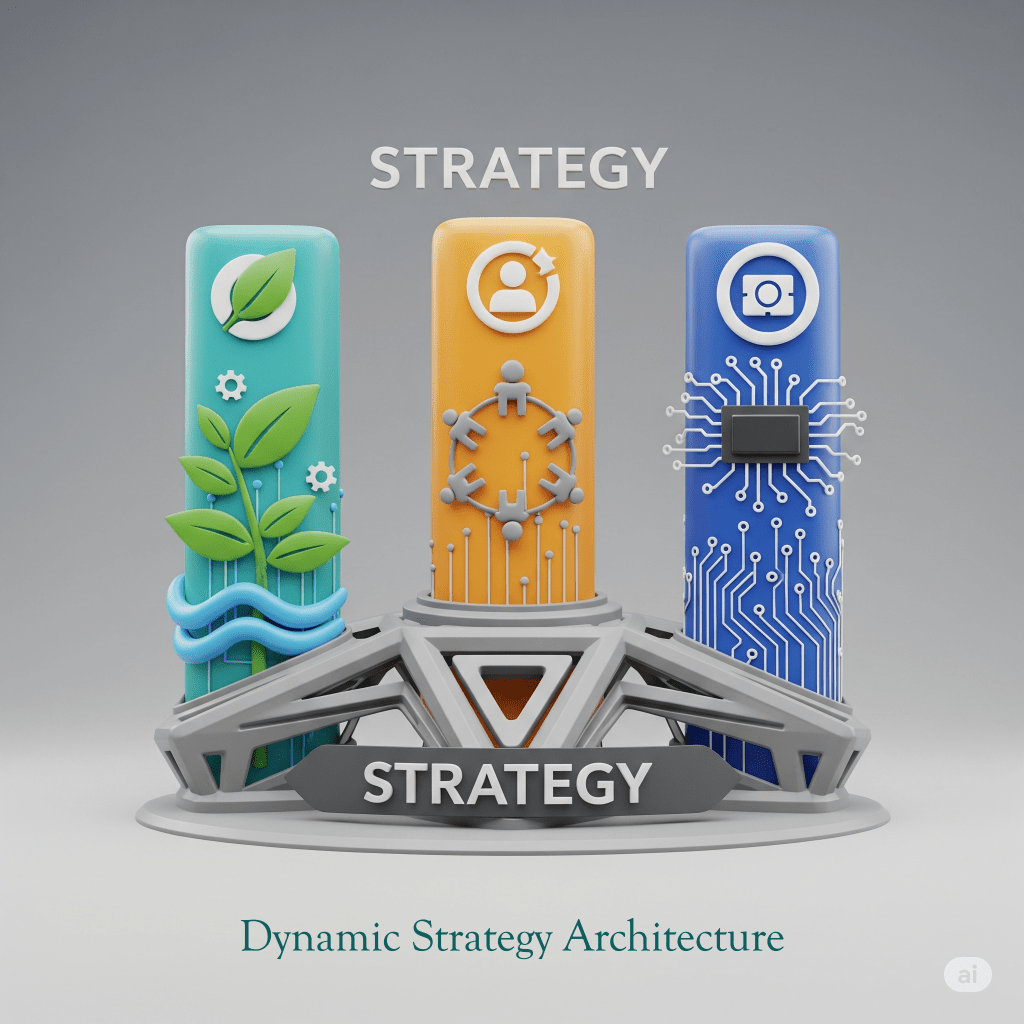
While financial performance remains essential, it is no longer the sole measure of success. Sustainable growth now depends on a company’s ability to address environmental and social responsibilities while harnessing the transformative power of digitalization. These three pillars – sustainability, social responsibility, and digitalization – are not standalone initiatives but interconnected forces that shape competitive advantage and long-term resilience.
This integrated approach is not new in principle. In 1994, John Elkington introduced the Triple Bottom Line (TBL), advocating for businesses to balance profit with ecological and social well-being. Elkington’s insight remains relevant today: to succeed, organizations must embed these priorities into their strategic core – not as afterthoughts or compliance measures, but as essential drivers of value creation.
We are not merely adapting to change; we are shaping the future. By embracing these three foundational pillars, we are forging a path towards a more sustainable, equitable, and prosperous world – a world where businesses thrive not at the expense of society and the environment, but in harmonious synergy with them.
INTEGRATED SUSTAINABILITY
In the 21st century, sustainability is no longer a peripheral concern – it is the foundation of lasting business success. A strategy that embeds sustainable value at its core not only meets ethical imperatives but also drives significant financial and operational gains. It’s about creating an enterprise built to thrive long-term, where ecological responsibility and economic prosperity are deeply interconnected.
Consider the compelling financial argument. Bob Willard (2012), in “The New Sustainability Advantage”, paints a vivid picture: companies that embrace the Triple Bottom Line – people, planet, profit – aren’t just ethically sound; they’re financially formidable. Willard’s research suggests potential profit increases of 51% to 81% within five years, a testament to the power of integrating sustainability into strategic DNA. This surge isn’t just about cutting costs; it’s about unlocking new revenue streams, attracting top talent, and mitigating the very risks that can cripple a business.
Think about it: increased market share from conscious consumers, reduced operational costs through resource efficiency, a highly engaged and innovative workforce attracted by a purpose-driven culture. These are not mere aspirations; they are tangible benefits. But the true power of sustainable value lies in its holistic approach. It’s about recognizing that a company’s success is intrinsically linked to the health of the communities in which it operates.
Take Patagonia, for example. They haven’t just bolted sustainability onto their business model; they’ve built their entire strategy around it. Their mission, “We’re in business to save our home planet,” isn’t just a tagline; it’s a guiding principle that permeates every aspect of their operations. From their commitment to using recycled materials and reducing waste to their “Don’t Buy This Jacket” campaign, Patagonia demonstrates that authentic sustainability can drive both profitability and brand loyalty. They understand that their customers, and their employees, are drawn to a company that genuinely cares about the planet. They are not merely selling products; they are selling a set of values, and a future.
Sustainable communities, like the ones Patagonia supports, are fertile ground for innovation and talent. When businesses prioritize environmental conservation, social equity, and economic prosperity, they create an ecosystem where individuals flourish. This, in turn, fosters a workforce that is not only skilled and motivated but deeply invested in the organization’s long-term success. They become the linchpin of resilience, a testament to the symbiotic relationship between human capital and sustainable growth.
Embracing sustainable value isn’t just a smart business decision; it’s a strategic imperative. It’s about building a future where businesses thrive by creating a world that thrives.
WEAVING SOCIAL RESPONSIBILITY into the HEART of ENTERPRISE
Beyond the balance sheets and bottom lines lies the heart of enterprise: social responsibility. It’s not a mere addendum to strategy; it’s the very fabric that binds a company to its community and its future. True sustainability is unattainable without a deep commitment to fostering an equitable and flourishing world. This isn’t just about mitigating negative impacts; it’s about actively creating positive change, enriching the lives of those around us while pursuing economic objectives.
Imagine a company that sees its success as intrinsically linked to the well-being of its communities and the health of the planet. This is the essence of social responsibility: a proactive, purposeful engagement that extends beyond compliance and philanthropy to encompass ethical sourcing, fair labor practices, diversity and inclusion, and a relentless pursuit of a reduced carbon footprint. It’s about empowering employees through volunteerism, supporting local initiatives, and building a legacy of positive impact.
Consider Ben & Jerry’s. Their mission isn’t just to sell ice cream; it’s to create linked prosperity for everyone connected to their business. From sourcing Fairtrade ingredients to advocating for social justice issues, Ben & Jerry’s demonstrates that a company can be both profitable and deeply committed to social responsibility. They understand that their customers, and their employees, are drawn to a company that stands for something more than just profit. They use their business as a platform to drive social change, demonstrating that responsible business practices are not just good for society, they’re good for business.
A shining example of social responsibility as a strategic cornerstone is Ben & Jerry’s, the iconic ice cream company. Since its inception, Ben & Jerry’s has championed social justice, environmental protection, and sustainable food systems. Its “Justice ReMix’d” initiative, aimed at reforming criminal justice systems, exemplifies its commitment to societal impact. The company also supports Fairtrade practices and partners with social equality groups, ensuring its operations align with its values. This unwavering dedication to social responsibility has not only solidified Ben & Jerry’s reputation, drawing in customers and employees who value a company that stands for something more than profit, but has also contributed to its commercial success, demonstrating that doing good and doing well can go hand in hand.
In a world increasingly driven by purpose, the pressure on companies to embrace social responsibility is mounting. Job seekers, consumers, suppliers, and investors are voting with their feet, actively seeking out organizations that align with their values. Companies that ignore their social and environmental responsibilities do so at their peril. They risk losing market share, alienating stakeholders, and ultimately, facing the very real threat of obsolescence.
Social responsibility is not a cost; it’s an investment – an investment in a more just, equitable, and sustainable future. It’s about building a company that not only thrives but also contributes to the thriving of the world around it. It’s about recognizing that true success is measured not just in financial terms, but in the positive impact we leave behind.
THE IMPERATIVE OF DIGITALIZATION
In the modern business landscape, digitalization is no longer optional – it is the foundation of competitive advantage and long-term success. Companies that fully integrate digital technologies into their strategies are not merely adapting to change; they are shaping the future of their industries. From cloud computing and data analytics to Artificial Intelligence (AI) and Generative AI (GenAI), the digital revolution is redefining how businesses operate, innovate, and create value.
At its core, digital transformation is more than just adopting new tools – it is about reimagining business models, processes, and customer interactions. AI and GenAI, for example, are revolutionizing decision-making, automating complex tasks, and enabling hyper-personalized customer experiences at scale. Companies that fail to embrace these technologies risk being left behind, unable to keep pace with evolving market expectations and the efficiency of their digital-first competitors.
A striking example of a company that built its strategy around digitalization is Siemens. Through its Siemens Xcelerator platform, the industrial giant has embraced AI, IoT, and digital twins to drive innovation across manufacturing, infrastructure, and mobility. This ecosystem seamlessly integrates hardware and software, enabling companies to optimize operations, reduce inefficiencies, and accelerate time-to-market. By embedding digitalization at its core, Siemens has not only strengthened its own business but also empowered its customers to transition toward smarter, more sustainable operations.
Without digital transformation, businesses risk being locked out of the evolving digital economy, unable to participate in fully digital supply chains, customer networks, and AI-driven ecosystems. The future belongs to organizations that recognize digitalization not as a one-time upgrade, but as an ongoing journey – one that continuously reshapes how they compete, collaborate, and create lasting value.
ARCHITECTING TOMORROW: BUILDING RESILIENT STRATEGIES WITH THE THREE PILLARS OF PROGRESS
In the 21st century, embedding sustainability, social responsibility, and digitalization into the strategic framework is no longer a forward-thinking aspiration – it is a necessity. By integrating these three pillars alongside their established long-term commitments, organizations can craft strategies that are:
- Relevant: Strategies attuned to the latest environmental, social, and digital developments empower organizations to navigate the complexities of the modern world. Organizations that proactively address regulatory changes, meet consumer expectations for sustainability, leverage emerging digital innovations for competitive advantage, and address social issues that impact reputation and operational efficiency will navigate disruption more effectively and position themselves for long-term success.
- Responsible: Integrating social and environmental considerations is not just about compliance; it’s about building trust and forging unbreakable bonds of loyalty. Modern consumers, empowered by information and driven by values, are demanding a new era of corporate responsibility. Companies that embrace this shift are not just doing good; they’re doing smart business. Employees, too, are drawn to organizations that align with their values, becoming passionate advocates and loyal contributors.
- Future-Proof: In an unpredictable business environment, organizations that embed these three pillars into their strategies gain resilience. Sustainable operations reduce environmental risks, social responsibility enhances brand reputation, and digitalization drives efficiency and innovation – ensuring long-term relevance and adaptability.
Furthermore, this integrated framework fuels:
- Innovation: The convergence of sustainability and digitalization creates fertile ground for innovation. Organizations that embrace this convergence are not just adapting; they’re pioneering new frontiers, developing disruptive business models and creating products and services that resonate with the values of the future. The digital transformation era demands a holistic reimagining of business, where innovation is not just a technological pursuit but a cultural imperative.
- Differentiation: Businesses that integrate these three pillars stand out in increasingly crowded markets. By championing responsible business practices and harnessing cutting-edge technology, they attract top talent, win customer loyalty, and secure investment from socially conscious stakeholders.
- Enduring Value Creation: The ultimate goal is not just profit but lasting impact. Strategies built on sustainability, social impact, and digital excellence generate lasting value for both businesses and society. This approach aligns with the growing preference for ethical and sustainable enterprises, ensuring long-term financial performance while contributing to broader economic and environmental well-being.
One company that has successfully embedded sustainability, social responsibility, and digitalization into its strategy is Schneider Electric. As a global leader in energy management and automation, Schneider Electric has placed sustainability at the core of its operations, aiming to be carbon-neutral by 2025 and net-zero by 2050. Its “Schneider Sustainability Impact” program drives resource efficiency, circular economy initiatives, and carbon footprint reduction.
Beyond environmental sustainability, the company champions social responsibility, focusing on energy access for underserved communities and ethical supply chain practices. Through its Access to Energy program, Schneider Electric has brought electricity to millions in developing regions, while also investing in workforce diversity and inclusion initiatives.
Schneider Electric’s digital transformation efforts complement these sustainability and social responsibility goals. Its EcoStruxure platform leverages AI, IoT, and automation to optimize energy use, reduce emissions, and enhance efficiency across industries. This commitment to digitalization has enabled Schneider to offer intelligent solutions that drive sustainability for both itself and its customers.
By embedding all three pillars into its strategy, Schneider Electric demonstrates how businesses can achieve long-term profitability while making a meaningful impact on society and the environment. It is a testament to the fact that sustainability, social responsibility, and digitalization are not just complementary forces – they are essential drivers of future success.
THE DANGERS OF RETROACTIVE STRATEGY ADJUSTMENTS
Failing to embed sustainability, social responsibility, and digitalization into strategy from the outset forces companies into reactive, often superficial adjustments during implementation. These last-minute fixes rarely align with an organization’s long-term vision, leading to fragmented initiatives that lack depth, coherence, and credibility. Instead of driving real transformation, they risk being perceived as performative gestures – public relations exercises rather than strategic imperatives.
A key misstep is treating ESG reporting as a substitute for genuine integration. It’s a snapshot, not a roadmap. While ESG disclosures provide transparency, they do not inherently shape decision-making or ensure long-term value creation. Companies that rely solely on compliance-driven ESG initiatives often find themselves lagging behind competitors who have fully embedded these principles into their operations and culture.
True competitive advantage comes from proactive, strategic alignment. When sustainability, social responsibility, and digitalization are treated as fundamental pillars – woven into every aspect of decision-making – companies unlock new opportunities for growth, resilience, and long-term success.
BUILDING STRATEGIES THAT ENDURE
The three-pillar strategy foundation – sustainability, social responsibility, and digitalization – is not simply a framework but a call to action. By embedding these principles into their strategic DNA, organizations can position themselves as leaders in shaping a future that is equitable, sustainable, and technologically advanced. This holistic approach ensures relevance, resilience, and enduring value creation, enabling businesses to thrive amidst the complexities of the modern era.
True success lies in proactive integration, not superficial adjustments. Leaders must embrace adaptive, inclusive, and forward-thinking strategies that align their aspirations with the realities of our interconnected world. In doing so, they pave the way for progress that benefits both society and business, making a lasting impact for generations to come.
