
Where human ingenuity meets AI revolution to transform uncertainty into opportunity.
🔹 The Human Layer of Strategy
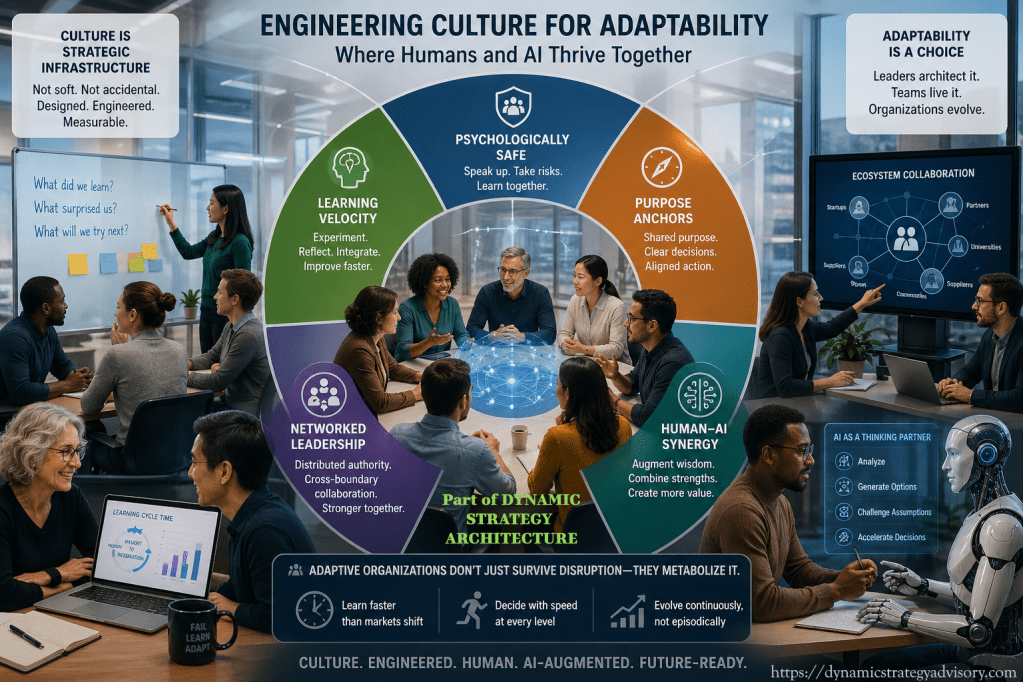
In an age of volatility and complexity, culture isn’t a soft metric – it’s strategic infrastructure.
Culture is the oxygen that sustains adaptability, innovation, and momentum. It shapes how teams respond to uncertainty, how leaders model clarity, and how organizations metabolize change. Dynamic Strategy Leadership demands a culture designed for agility and resilience – not as an afterthought, but as a deliberate boardroom priority.
🧠 Leadership Shapes Culture – and Strategy
Organizational culture flows directly from the top. Leaders don’t just manage strategy; they actively cultivate the environment in which it flourishes. By defining values, setting norms, and influencing behaviors through vision, communication, and modeling, leaders create the very conditions for strategic success. Dynamic organizations don’t just have culture – they shape it deliberately. It’s a boardroom priority.
Five Cultural Pillars for Adaptive Organizations
To build truly adaptive organizations capable of thriving amidst disruption, focus on cultivating these five essential cultural pillars:
1. 🌱 Psychological Safety 2.0
Encourages a climate where employees feel safe to take calculated risks, voice new ideas, ask questions, and even “fail fast” without fear of punishment. This fosters experimentation and is the bedrock of innovation.
- Human Side: Encourage dissent (e.g., “Red Team Fridays” to challenge strategies).
- AI Boost: Use sentiment analysis tools to detect unspoken concerns in team communications.
2. ⚡️ Learning Velocity
Prioritizes rapid learning from both successes and failures. It’s about building mechanisms like after-action reviews to continuously capture insights, disseminate knowledge, enable fast iteration and integrate lessons learned across the organization at speed. It will boost strategic responsiveness, and sharper decision-making under pressure.
- Human Side: After-action reviews that reward “intelligent failures.”
- AI Boost: Predictive analytics flag skills gaps before projects stall.
3. 🧭 Purpose Anchors
Provides stability and direction amid chaos by anchoring the organization to a clear, compelling purpose (e.g., Patagonia’s environmental mission). This shared purpose serves as an unwavering guide for strategic decisions and galvanizes engagement.
- Human Side: Tie daily work to mission (e.g., “How your code reduces carbon emissions”).
- AI Boost: GenAI crafts personalized purpose narratives for employees.
4. 🌐 Networked Leadership
Promotes decentralized decision-making and empowers agile teams throughout the organization. This fosters agility, boosts collaboration enabling quicker responses to localized challenges and opportunities without rigid hierarchical bottlenecks.
- Human Side: Decentralize decisions to frontline teams.
- AI Boost: AI-driven dashboards provide real-time data for autonomous choices.
5. 🧠🤖 Synergy between Human and Artificial Intelligence
In this new era, competitive advantage stems from effectively combining human ingenuity with AI’s analytical power. It’s about recognizing that innovation isn’t just human, it’s human plus AI. Leaders must champion this collaborative intelligence, fostering a culture where:
- Bilingual Thinking balances data-driven insights from AI with essential human intuition.
- Vulnerability as Strength; leaders openly leverage AI to bridge knowledge gaps (“I don’t know – let’s ask the AI”).
- An Architect Mindset designs systems where humans and AI complement each other, rather than compete.
Digital platforms elevate feedback into strategic insight, and collaboration tools unlock knowledge sharing at scale. AI augments human judgment, enabling faster, smarter adaptation and empowering employees to share ideas, solve problems, and push boundaries. The result is a culture that’s not only open, but intelligent, curious, and dynamic.
🔚 Culture as the Strategic Engine of Adaptability
Strategy adapts when culture enables it.
Leadership thrives when culture reflects it.
Organizations endure when culture empowers them to evolve.
In the volatile terrain of the 21st century, culture is not background – it’s strategic infrastructure. The five cultural pillars outlined above form the human backbone of Dynamic Strategy Leadership, transforming adaptive ambition into operational reality.
- They don’t just support strategy – they activate it.
- They don’t just shape behavior – they scale resilience.
- They don’t just manage uncertainty – they metabolize it.
Leaders who deliberately cultivate these pillars aren’t just navigating the VUCA world – they’re designing organizations built to flourish in it. This is culture as competitive advantage. This is leadership that lasts.
Want to Go Deeper?
To dive deeper check out my article “Culture as Competitive Advantage: Five Pillars for Building Adaptive Organizations”.
