

When Strategy Collides with Culture
Culture has never been background. It has always been the invisible architecture shaping whether strategies succeed or stall – not in the boardroom slides, but in the lived behaviors and norms that determine whether organizations can adapt. Two contrasting stories illustrate this truth.
At the dawn of the smartphone era, Nokia was the undisputed leader in mobile phones. It had the technology, the talent, and even prototypes of touchscreens and cloud services years before the iPhone. Yet between 2007 and 2013, Nokia lost its dominance and collapsed into irrelevance. Scholars and insiders point to a culture of fear, silos, and risk aversion that blocked innovation. Engineers hesitated to escalate bad news. Managers avoided dissent. Decision‑making slowed to a crawl. The company didn’t lack strategy – it lacked a culture that could metabolize disruption. By the time leadership recognized the urgency, competitors like Apple and Google had already reshaped the market.
In contrast, when Satya Nadella became CEO of Microsoft in 2014, he didn’t begin with a sweeping strategic plan. He began with culture. Nadella sent employees a memo titled “Pulling Together” and distributed a book on empathy. His deliberate shift from a “know‑it‑all” to a “learn‑it‑all” culture dismantled silos, encouraged curiosity, and fostered collaboration. Over the next decade, Microsoft’s market value soared from about $300 billion to more than $2.5 trillion, fueled by cloud computing and AI – but enabled by cultural transformation.
Same industry volatility. Same technological disruption. Radically different outcomes. The difference? One organization treated culture as background; the other engineered it as strategic capability.
Traditional strategy approaches assume stability and treat culture as background noise – nice to have, but not mission‑critical. What has changed in the 21st century is the visibility and urgency of culture as strategic infrastructure. In today’s environment of AI disruption, geopolitical volatility, and distributed work, this assumption is dangerous. Culture isn’t what happens after strategy – it determines whether strategy achieves its goals fully, partially, or falls short altogether.
Reframing Culture – From Soft Variable to Strategic Infrastructure
Decision cycles are compressing – what once took months now takes weeks. Authority is distributing – frontline teams increasingly require autonomous capability. Human–AI collaboration is becoming standard, not exceptional. And market volatility rewards learning speed over planning precision. In this environment, culture is no longer atmosphere – it is the invisible architecture that determines how organizations behave under uncertainty.
Just as physical infrastructure (roads, networks) enables economic activity, cultural infrastructure enables strategic execution. It shapes how quickly organizations learn, how effectively they make decisions, and how well they metabolize disruption rather than react to it.
Three capabilities distinguish culture as strategic infrastructure. First, speed of learning: how quickly organizations extract, share, and act on insights. Second, quality of decisions: whether the right people have access to the right information at the right time. Third, capacity for change: the ability to adapt continuously, rather than manage change as a series of isolated initiatives.
Consider Amazon’s “Day 1” culture, deliberately engineered by Jeff Bezos to maintain startup agility at scale. When asked what “Day 2” looks like, Bezos answered: “Day 2 is stasis. Followed by irrelevance. Followed by excruciating, painful decline. Followed by death.” To prevent this, Amazon engineered specific practices: categorizing decisions into reversible “two-way doors” made quickly with 70% information versus irreversible “one-way doors” requiring deeper analysis; distributing authority so teams don’t wait for directives; using narrative memos to ensure clear thinking; treating customer obsession as the North Star enabling autonomous decisions. These aren’t inspirational principles – they’re architectural design choices shaping daily behavior.
The design imperative is clear: Leaders must shift from passive stewardship to active cultural engineering. Adaptive strategy requires adaptive culture; you cannot bolt agility onto rigid foundations. This necessity is underscored by McKinsey research showing that 70% of organizational transformations fail to achieve their goals, with cultural misalignment cited as the most common reason for strategic collapse.1
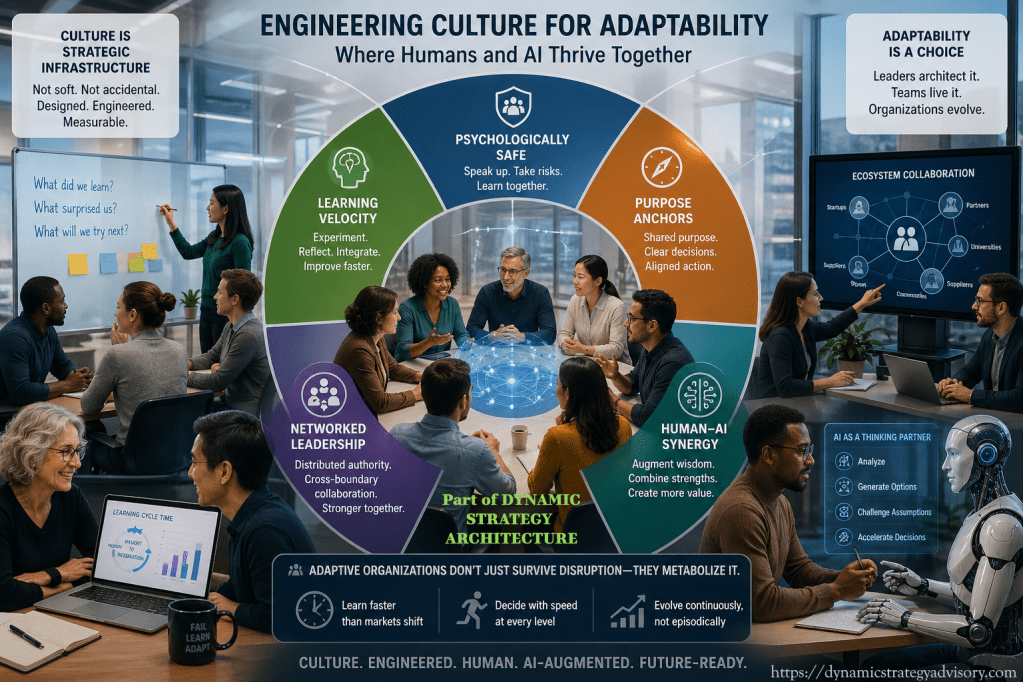
This article introduces five cultural pillars – Psychological Safety 2.0, Learning Velocity, Purpose Anchors, Networked Leadership, and Human-AI Synergy – that together form the strategic infrastructure for organizational adaptability. When deliberately cultivated, these pillars transform adaptive ambition into operational reality.
The Five Cultural Pillars of Adaptive Organizations
Five interconnected pillars form the cultural architecture of adaptive organizations. They don’t just support strategy – they activate it. They don’t just shape behavior – they scale resilience. They don’t just manage uncertainty – they metabolize it.
Pillar 1: Psychological Safety 2.0
Amy Edmondson’s foundational research established psychological safety – the climate where people feel safe to speak up, take risks, and acknowledge mistakes – as essential for team learning.2 Google’s Project Aristotle reinforced this, identifying psychological safety as the number one factor distinguishing high-performing teams.3 But adaptive organizations in the AI era need more than interpersonal comfort. They need strategic dissent as deliberate practice.
Psychological Safety 2.0 extends the concept in three critical directions. First, organizations must institutionalize structured challenge mechanisms. Red Team sessions, pre-mortem exercises, and designated devil’s advocates transform dissent from a personality trait into an organizational capability. Second, teams must feel safe questioning not just human decisions but algorithmic outputs. As AI increasingly augments decision-making, the ability to challenge machine-generated recommendations becomes as vital as challenging a colleague’s proposal. Third, failure must be treated as learning infrastructure. “No blame” post-mortems with documented insights ensure that mistakes become organizational knowledge rather than buried embarrassments.
Microsoft’s cultural transformation illustrates this evolution. The elimination of stack ranking – a system that pitted employees against each other – and the emphasis on empathy in leadership created conditions where employees felt empowered to experiment, share half-formed ideas, and collaborate across boundaries. This wasn’t soft culture work. It directly enabled the innovation that drove Azure’s explosive growth and Microsoft’s cloud leadership.
For leaders, Psychological Safety 2.0 is an active practice. It means publicly questioning AI outputs, inviting dissent in high-stakes decisions, celebrating intelligent failures, and modeling vulnerability when navigating new technologies. Without it, organizations suppress the very signals they need to adapt. With it, they unlock faster learning, better decisions, and sustained innovation.
Pillar 2: Learning Velocity
Peter Senge’s concept of the learning organization established that competitive advantage flows from an organization’s capacity to learn faster than rivals.4 Eric Ries’s lean startup methodology added urgency with “fail fast, learn faster”.5 In volatile markets where disruption compresses timeframes, the critical variable isn’t whether organizations learn – it’s how quickly they do. Learning Velocity treats speed as a measurable organizational capability. The organization that learns in days beats the one that learns in months, not because it’s smarter but because its culture metabolizes information faster.
High-velocity learning requires three mechanisms. First, systematic capture through after-action reviews conducted within 48 hours of significant events, transforming experience into documented insight before details fade or narratives calcify. Second, cross-functional knowledge flows via communities of practice, rotation programs, and searchable knowledge bases that prevent insights from remaining trapped in silos. Third, AI-enabled pattern recognition that identifies skill gaps and emerging trends in real time, accelerating the organization’s ability to spot what matters.
NASA’s disciplined after action reviews process illustrates this infrastructure in action. By treating every mission as a data-harvesting exercise, NASA ensures that frontline learnings quickly reach decision-makers to prevent repeated mistakes. This isn’t just archiving; it’s a systematic flow that scales resilience in high-stakes environments.
Amazon offers another example: its narrative memo culture forces teams to document reasoning and outcomes, ensuring insights don’t remain trapped in individual minds but circulate across the enterprise.
For leaders, Learning Velocity means measuring time-from-insight-to-integration: How long does a frontline discovery take to reach decision-makers? How quickly do documented lessons change behavior? It means rewarding knowledge sharing over knowledge hoarding, and designing systems where learning compounds rather than dissipates.
Pillar 3: Purpose Anchors
Simon Sinek’s “Start With Why” established that purpose acts as both motivator and decision filter, enabling organizations to inspire action rather than merely direct it.6 Examples of purpose-driven organizations like Patagonia reinforces this: companies with a clear, compelling purpose demonstrate higher engagement and more consistent decision-making under pressure. But in volatile environments where strategies shift rapidly and authority distributes widely, purpose serves an even more critical function – it provides the alignment mechanism that enables autonomous action without chaos.
Purpose Anchors work through three mechanisms. First, Commander’s Intent, borrowed from military strategy: communicating the desired end state so clearly that frontline teams can improvise tactics without seeking permission, provided they stay aligned with the core objective. Second, Values-Based Filters – non-negotiables that guide trade-offs and prevent short-term optimization – often amplified by AI – from eroding long-term integrity. Third, Strategic Continuity, which allows organizations to change what they do (Netflix moving from DVDs to streaming) without losing why they do it.
Patagonia’s environmental mission exemplifies this infrastructure. When the pandemic disrupted retail, Patagonia pivoted to direct-to-consumer without fracturing employee alignment because the mission – “save our home planet” – provided unwavering guidance. Distributed teams made autonomous decisions aligned with purpose, waiting for neither approval nor clarification.
Microsoft’s purpose transformation under Nadella – shifting to “empower every person and organization on the planet to achieve more” – provided a North Star that enabled teams to innovate independently across cloud, AI, and devices.
For leaders, Purpose Anchors require concrete articulation in decision-relevant terms, not platitudes. They must be embedded as filters in resource allocation, strategic choices, and daily operations. The paradox: strong purpose enables decentralization. When everyone understands the “why,” they need less direction on the “how”. Without anchors, distributed authority drifts into fragmentation. With them, autonomy aligns with strategy.
Pillar 4: Networked Leadership
Frederic Laloux’s research on Teal Organizations demonstrated that self-management enables faster adaptation by distributing authority throughout the organization rather than concentrating it at the top.7 Brian Robertson’s Holacracy framework codified this into operational practice, with many organizations adopting elements of decentralized decision-making.8 In volatile markets where decision speed determines survival, traditional hierarchies create fatal bottlenecks. Frontline teams possess better market intelligence than executives, yet wait for approval while opportunities vanish.
Networked Leadership extends beyond structural decentralization in three critical directions. First, clear decision rights must be codified using frameworks like RACI (Responsible, Accountable, Consulted, Informed) charts or delegation boards that specify exactly who decides what – eliminating the ambiguity that drives unnecessary escalation. Second, data democratization requires real-time dashboards accessible to frontline teams, not just executives, replacing approval chains with actionable intelligence. Third, cross-functional autonomy demands structures like squads or pods that operate within strategic guardrails but own their execution end-to-end.
Spotify’s squad model demonstrates this architecture at scale. Distributed teams maintain decision-making autonomy within clear architectural boundaries, enabling speed without incoherence. Microsoft’s “One Microsoft” restructuring under Nadella was equally structural: breaking down silos required redesigning decision rights and information flows, not just changing cultural messaging.
AI accelerates this shift. Decentralized teams equipped with predictive dashboards and real-time market signals can respond faster than any centralized approval process could authorize.
But Networked Leadership carries a critical dependency: it requires Purpose Anchors to function. Distributed authority without shared purpose doesn’t produce agility – it produces fragmentation. This is the essential connection between Pillars 3 and 4.
The leadership role transforms accordingly: from making decisions to designing decision systems, from controlling information to democratizing access.
Pillar 5: Human-AI Synergy
Gartner’s research on the augmented workforce and McKinsey’s human-in-the-loop AI models reveal a consistent finding: technology adoption fails when culture doesn’t support it.9, 10 Organizations struggle with AI not because the technology doesn’t work, but because teams lack norms for when to trust versus question AI outputs, and leaders fail to model “bilingual thinking” – the seamless integration of human intuition and machine logic. Human-AI Synergy treats this collaboration as a cultural capability, not a technical implementation. If human ingenuity is the spark, AI is the furnace that allows it to thrive in a complex world, handling the cognitive load of data synthesis so leaders can focus on the “Strategic Ingenuity” that only empathy, ethics, and long-term vision provide.
Human-AI Synergy extends beyond tool adoption in four critical directions. First, augmented humility requires leaders to openly say “I don’t know – let’s ask the AI”, modeling that intelligence is amplified, not threatened, by machine assistance. Second, domain clarity demands frameworks distinguishing human-led decisions (empathy, ethics, long-term vision), AI-assisted decisions (data synthesis, pattern recognition, scenario modeling), and AI-led decisions (anomaly detection, routine optimization with human oversight). Third, human-in-the-loop design: workflows are built to include oversight, iteration, and critical evaluation, ensuring that AI enhances rather than replaces judgment. Fourth, critical evaluation training teaches teams to interpret, challenge, and refine AI outputs – treating algorithmic recommendations as starting points, not final answers.
Examples illustrate the principle. Aidoc’s diagnostic AI acts as a co‑pilot in healthcare, enhancing speed and accuracy while leaving ultimate decisions to physicians. BenevolentAI’s drug discovery platform accelerates research by surfacing novel targets that scientists then validate, cutting timelines by more than a year in ALS studies. PwC integrates generative AI into consulting, tax and audit workflows as standard practice, embedding human–AI collaboration into daily routines rather than treating it as a special project.
Human-AI Synergy is the capstone pillar because it requires all four predecessors: Psychological Safety to question AI outputs without fear, Learning Velocity to evolve AI fluency continuously, Purpose Anchors to guide where AI should and shouldn’t lead, and Networked Leadership to distribute AI capability across the organization rather than concentrating it in technical elites. The ingenuity remains human. The furnace is shared.
Implications for Senior Leaders
The five pillars don’t implement themselves. They require leaders who treat culture not as an emergent property to be stewarded, but as a designed system to be engineered. In volatile environments, the distinction is existential.
This begins with unlearning. Senior leaders must abandon the assumption that culture can be delegated to HR, that values posters constitute cultural infrastructure, or that their authority depends on having answers. The more disorienting shift is temporal: replacing patience with evolution with urgency of transformation. Adaptive cultures are not grown – they are architected, deliberately and fast.
The redesign agenda is concrete. Decision rights must be redistributed to enable Networked Leadership. Performance metrics must be rewired to reward what actually matters in volatile environments: learning cycle times (insights to integration), decision velocity at different organizational levels, employee confidence in autonomous action, and the quality of human-AI collaboration. Meeting rhythms must institutionalize after-action reviews and structured dissent – making reflection an operational habit, not an occasional retreat. Information flows, data access architecture, learning systems, and AI oversight mechanisms all require intentional design, not organic accumulation.
But systems without behavioral modeling fail. Leaders must demonstrate the very capabilities they ask of their organizations. Vulnerability – “I don’t know, let’s explore together” – signals that psychological safety is real, not rhetorical. Public curiosity about failure accelerates learning velocity across the organization. Augmented humility, using AI openly as a thinking partner, normalizes Human-AI Synergy at every level beneath them.
Linda Hill and her co-authors’ recent Genius at Scale reinforces this shift, identifying three roles essential to scaling innovation: the architect who shapes culture for co-creation, the bridger who connects talent across boundaries, and the catalyst who accelerates ecosystem collaboration.11 Their focus is innovation specifically; this article argues for the broader cultural infrastructure that makes organizations adaptable, innovatively proactive, and resilient across every dimension of AI-driven volatility.
The leader’s role is thus redefined. Not as culture curator – preserving and protecting what exists – but as chief architect and behavioral role model: designing the systems and demonstrating the behaviors that make adaptability possible.
Conclusion: Designing Organizations That Can Evolve
Leaders face a choice. They can continue treating culture as soft background noise, or they can recognize it as hard infrastructure that determines strategic success. The evidence is stark. Microsoft’s market value increased by more than $2 trillion through deliberate cultural engineering – embedding empathy, collaboration, and growth mindset into its operating system. Southwest Airlines, by contrast, saw its value decline by 50 percent despite a strong brand legacy, hampered by cultural rigidity that left it unable to adapt. Same volatile environment. Different cultural choices. Radically different outcomes.
The opportunity is clear. By deliberately engineering the five cultural pillars – Psychological Safety 2.0, Learning Velocity, Purpose Anchors, Networked Leadership, and Human-AI Synergy – leaders build organizations that don’t just survive disruption; they metabolize it. These organizations learn faster than markets shift, decide with the speed distributed authority enables, and evolve continuously rather than episodically.
This requires elevating culture to where strategy lives. Diagnose it with the rigor applied to financial performance. Design it with the intentionality applied to organizational structure. Measure it through learning cycle times, decision velocity, and collaborative output. Model it from the top, visibly and consistently.
The question is no longer whether culture matters. The question is whether leaders are intentionally engineering the culture their strategy requires – or hoping it will evolve on its own.
Strategy without cultural infrastructure is wishful thinking.
Culture, deliberately engineered, is competitive advantage.
References:
- Scott Keller and Carolyn Dewar, “The Irrational Side of Change Management”, McKinsey Quarterly, April 1, 2009, https://www.mckinsey.com/capabilities/people-and-organizational-performance/our-insights/the-irrational-side-of-change-management.
- Amy C. Edmondson, “Psychological Safety and Learning Behavior in Work Teams”, Administrative Science Quarterly 44, no. 2 (1999): 350-383, https://doi.org/10.2307/2666999.
- Julia Rozovsky, “The Five Keys to a Successful Google Team”, re:Work with Google, November 17, 2015, https://www.bishophouse.com/wp-content/uploads/2018/01/The-five-keys-to-a-successful-Google-team.pdf.
- Peter M. Senge, The Fifth Discipline: The Art & Practice of The Learning Organization (New York: Doubleday/Currency, 1990).
- Eric Ries, The Lean Startup: How Today’s Entrepreneurs Use Continuous Innovation to Create Radically Successful Businesses (New York: Crown Business, 2011).
- Simon Sinek, Start with Why: How Great Leaders Inspire Everyone to Take Action (New York: Portfolio/Penguin, 2011).
- Frederic Laloux, Reinventing Organizations: A Guide to Creating Organizations Inspired by the Next Stage in Human Consciousness (Brussels: Nelson Parker, 2014).
- Brian J. Robertson, Holacracy: The New Management System for a Rapidly Changing World (New York: Henry Holt and Company, 2015).
- Don Scheibenreif, “Autonomous Business Is Coming, Powered by AI”, Gartner, October 14, 2025, https://www.gartner.com/en/articles/what-is-autonomous-business.
- Eric Lamarre et al., Rewired: The McKinsey Guide to Outcompeting in the Age of Digital and AI (Hoboken, NJ: Wiley, 2023).
- Linda Hill et al., Genius at Scale: How Great Leaders Drive Innovation, (Harvard Business Review Press, 2026).
