
The Gap between Strategy and Results
Despite the effort and ambition behind strategic planning, most business strategies fail to deliver. Multiple studies estimate that between 60% and 90% of strategic plans never fully launch or achieve their intended outcomes. While the reasons vary – from volatile market dynamics to internal misalignment – execution remains the most persistent and cited point of failure. Reinforcing this, a recent Gartner study found that only 43% of executives believe their organizations are highly effective at evaluating their capacity to execute strategy (Kumar, 2025).
Worse, the underlying problem is systemic: traditional execution models are too rigid for today’s volatile, uncertain, complex, and ambiguous (VUCA) environment. These legacy frameworks assume strategy flows linearly – from formulation to implementation – ignoring the feedback loops and agility needed to respond to emerging disruptions. Most models don’t integrate human machine collaboration, real time risk sensing, or iterative adaptation. Instead, execution becomes static – disconnected from learning, slow to pivot, and detached from the evolving reality organizations operate in.
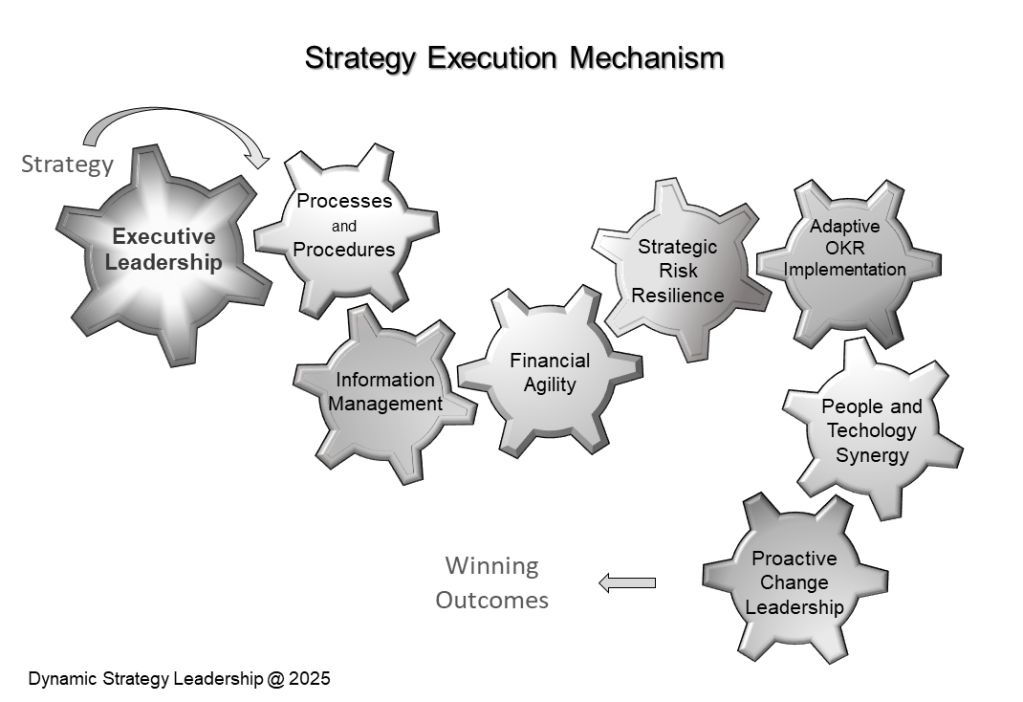
This article introduces a modern execution framework built for strategic adaptability. Rooted in my earlier work on the Dynamic Strategy Map – specifically its seventh step, Adaptive Execution – this framework presents a system of eight interconnected competencies that form the core of execution excellence (Milovanovich, 2025). These competencies are designed to embed coherence, responsiveness, and continuous learning into the fabric of execution. They enable organizations to operate as dynamic systems – capable of sensing change, orienting quickly, making informed decisions, and acting with precision. In short, this framework transforms execution from a mechanical process into a strategic capability, aligned with the complexities of the modern age.
The Evolution of Strategic Execution
For decades, scholars and practitioners have dissected why strategies fail – and what separates organizations that plan from those that deliver. The consensus is clear: execution is not an afterthought but a system of interdependent organizational strengths. When discussed together, these strengths form the backbone of successful execution.
The evidence reveals a compelling history of thought on this topic. Gary Hamel and C.K. Prahalad (1990) were among the first to emphasize that execution strength originates from core competencies – deeply embedded organizational know-how rooted in the collective learning and coordination of diverse skills and technologies.
Peter Drucker’s timeless distinction between doing things right and doing the right things – adapted from his writings on efficiency and effectiveness – underscores that setting direction and building an effective organization are essential to making strategy work (Drucker, 1963; Drucker, 1974). Lawrence Hrebiniak amplifies this, showing that culture and structure are execution’s make-or-break factors. He argued that process discipline and cross-functional alignment often falter because execution is treated as a technical challenge rather than a leadership imperative (Hrebiniak, 2005). Larry Bossidy and Ram Charan (2002) take it further, framing execution as a discipline in its own right – one where leaders must “own” the connection between people, processes, and financial rigor.
In today’s complex, data-rich environment, researchers have underscored the need for new organizational competencies. Douglas Laney (2017), along with Thomas Davenport and Jeanne Harris (2007), pioneered the view of information as a strategic asset – demonstrating how timely, actionable data can sharpen execution by enabling organizations to sense change, orient decisions, and act with precision. Building on this foundation, Paul Daugherty and James Wilson (2018) highlight the essential synergy between human judgment and technology, arguing that AI should augment – not replace – human capabilities.
This interplay between data and human insight demands organizational agility. Stéphane Girod and Martin Králik (2021) advocate for adaptive systems – spanning responsive finance, dynamic risk management, and proactive leadership – that can thrive amid uncertainty. Their perspective aligns with Jim DeLoach’s call to embed risk management into strategic thinking, not only to bolster resilience but also to surface new opportunities (DeLoach, 2017).
Ultimately, the success of this paradigm hinges on leadership. John Kotter’s seminal work reminds us that execution is change – a process requiring urgency, coalition-building, and clear communication (Kotter, 1996). William Joiner and Stephen Josephs (2007) extend this view with insights on leadership agility, showing that even the most robust strategies falter without leaders who can adapt, learn, and lead through complexity.
Today’s environment also demands ongoing learning and adaptation, including the continuous refinement of Objectives and Key Results (OKR), feedback integration, and iteration, as outlined in my recent work on adaptive execution (Milovanovich, 2025).
These authors, spanning different eras and specializations, all arrive at the same conclusion: successful execution depends on an integrated set of human and systemic competencies that organizations must intentionally develop and coordinate.
The Strategy Execution Engine – A System of Competencies in Motion
A brilliant symphony is worthless without the instruments to play it. Likewise, a stunning strategy is useless without the execution muscle to realize it.
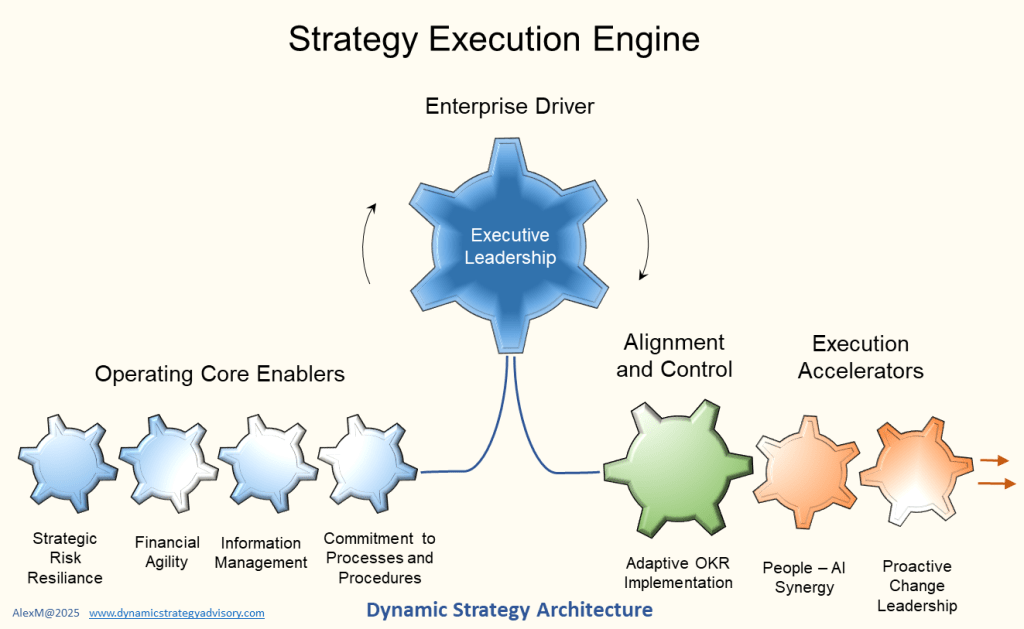
Most organizations know what they want to achieve, and many know how to start – but few possess a complete, integrated framework to keep execution moving at full power. This is why so many promising strategies stall or fade. To bridge this gap, I introduce the Strategy Execution Engine – a leadership-driven framework composed of eight core competencies. Leaders can use their own execution strength to activate and align the other seven, creating momentum across the organization.
The framework is organized into four functional sets:
I Enterprise Driver
At the heart of the system is Executive Leadership – the primary force that sets direction, drives accountability, and energizes the entire execution effort. It is the central competency that activates and sustains the rest.
II Operating Core Enablers
These four competencies form the foundation upon which execution rests:
- Commitment to Processes and Procedures
- Information Management
- Financial Agility
- Strategic Risk Resilience
Together, they build the organizational infrastructure needed to support strategic adaptability and operational excellence.
III Alignment & Control
This set contains a single but pivotal competency:
- Adaptive OKR Implementation
It ensures that all components of the system remain synchronized with strategic goals, adapting in real time to changing conditions and feedback.
IV Execution Accelerators
These two competencies energize and deliver outcomes:
- People–AI Synergy
- Proactive Change Leadership
They represent the direct actions and behaviors that translate strategy into reality, enabling organizations to move with speed, clarity, and resilience.
This Strategy Execution Engine is not a static model – it is a living system. Its power lies in its coherence, adaptability, and the ability of leaders to orchestrate its movement. The objective is not to perfect each competency in isolation but to cultivate a cohesive, adaptive whole – one in which leadership continuously drives, aligns, and energizes the engine. In the chapters ahead, we will explore each competency in depth, revealing how organizations can build the execution muscle required to deliver on their strategic promise.
The Eight Competencies of Execution Excellence
The following sections provide a detailed look at each of the eight competencies that form the Strategy Execution Engine, starting with the foundational driver.
1. Executive Leadership
At the heart of any effective strategy execution engine lies Executive Leadership – not a lone hero, but a cohesive, aligned team of leaders who serve as both strategists and execution drivers. While a strong CEO is indispensable, excellence comes when the entire C-suite moves as one – reflecting shared values, inspired direction, and tight collaboration. The CEO shapes culture, exemplifies integrity, and sets the tone – but must also assemble and motivate an executive team that reinforces the strategy across the organization.
A prime example is Alan Mulally’s tenure as CEO of Ford. When he took the helm in 2006, the company’s executive team was notoriously siloed and dysfunctional. Mulally didn’t simply impose a new strategy; he instituted a weekly Business Plan Review meeting where every senior leader was required to share progress, challenges, and concerns with complete transparency. This disciplined, uniform metrics-driven forum dismantled barriers, built trust, and fostered a culture of collaboration and shared accountability. By uniting the leadership team around the “One Ford” plan, Mulally transformed the company’s trajectory – moving from a $12.7 billion loss in 2006 to a $6.6 billion reported profit by 2010 – without accepting the government bailouts that competitors relied on during the financial crisis.
Execution begins at the top – but it succeeds only when leadership becomes a system, not a personality.
2. Commitment to Processes & Procedures
Strategy fails when execution relies on improvisation. Organizations that institutionalize process discipline turn strategic intent into repeatable, scalable action. This demands leadership’s explicit commitment to designing and institutionalizing workflows that mirror priorities, ensuring teams operate from the same playbook.
A contemporary example of this principle in action is Zara, the fast-fashion leader. Through a tightly integrated system, from design to production to store delivery, Zara transforms runway inspiration into retail inventory in just two to three weeks. It combines just-in-time inventory, real-time data feedback, in-house manufacturing, and workflows tied to daily Point of Sale data. Store managers report sales trends and customer feedback directly to designers, enabling rapid redesign and replenishment. As a result, Zara maintains minimal stock, responds swiftly to demand, and minimizes waste – all powered by disciplined, company-wide process orientation.
Process excellence isn’t bureaucracy – it’s the scaffolding for reliable execution. Companies that neglect this, as WeWork did by prioritizing aggressive expansion over financial controls and sound governance, waste resources and erode trust. WeWork’s unchecked leadership, opaque decision-making, and unsustainable growth model led to a failed IPO and eventual bankruptcy restructuring – a cautionary tale in execution without discipline.
When integrated with an agile framework, process discipline creates a self-correcting system where deviations trigger immediate adjustments rather than cascading failures.
3. Information Management
Timely, accurate, and actionable information fuels adaptive execution. It powers decision-making across all competencies – from process discipline to risk resilience – by enabling leaders to sense change, orient decisions, and act with precision. Information Management (IM) is not just a technical function; it’s a strategic capability encompassing how organizations create, collect, process, analyze, store, retrieve, and use information across people, processes, technology, and content.
In the AI era, IM must be designed to support a 24/7, globally distributed execution engine. Systems must be built around the needs of all users – employees, customers, partners, and increasingly AI agents – delivering real-time insights that drive agility, coordination, and autonomous action.
A compelling example is Mars Inc., which partnered with Celonis to deploy AI-powered process mining across its supply chain. By analyzing vast operational data, Mars identified inefficiencies in truck loading and proactively consolidated shipments – reducing costs, improving delivery speed, and enhancing sustainability. This illustrates how intelligent IM systems can elevate execution by turning raw data into strategic action.
Information Management is no longer about storage – it’s about strategic enablement. When integrated into the execution engine, it becomes the nervous system of the organization, sensing disruptions and enabling rapid, informed response.
4. Financial Agility
In an era of volatility, financial agility is essential to adaptive execution. It empowers organizations to respond to trade policy disruptions, interest rate uncertainty, and shifting customer behaviors with speed and precision. Agile financial management leverages digital technologies – AI, blockchain, and cloud platforms – to optimize working capital, enhance cash flow, and support dynamic decision-making.
This competency spans budgeting, forecasting, scenario planning, risk management, and strategic communication. It must be both flexible and resilient – able to reallocate resources, adjust forecasts, and trigger cross-functional action in real time.
Maersk, the global logistics leader, exemplifies how financial agility can be embedded into enterprise strategy. As part of its transformation into an end-to-end supply chain integrator, Maersk reengineered its financial planning and analysis capabilities using SAP S/4HANA Cloud ERP and SAP Analytics Cloud. This shift enables:
• Real-time financial forecasting across complex, multi-market operations
• Integrated planning and budgeting aligned with strategic objectives
• Automated decision support for capital allocation and risk management
• Scalable architecture that fuels continuous innovation and platform expansion
Maersk’s finance transformation is not just a technology upgrade – it’s a strategic enabler that aligns financial agility with enterprise-wide adaptability. By embedding finance into its digital platforms, Maersk ensures that every business decision is grounded in timely, trustworthy data.
5. Strategic Risk Resilience
Strategic risk resilience goes beyond threat mitigation – it builds adaptive capacity. It enables organizations to anticipate disruptions, safeguard assets, and turn uncertainty into opportunity. This competency requires identifying, evaluating, and managing risks across operations, while setting clear tolerance thresholds to guide decisions under uncertainty.
In the AI age, resilience demands a formal process for real-time monitoring and swift response. This requires fast, precise data analysis to act before risks materialize. AI is pivotal here, recognizing patterns, generating scenario models, and issuing predictive alerts that inform strategic choices.
A compelling example of this is Siemens, which leverages AI-driven risk monitoring to enhance supply chain resilience. Instead of reacting to disruptions like component shortages, manufacturing bottlenecks, or extreme weather, their AI-driven “digital twin” of the supply chain continuously models both internal and external factors. This allows Siemens to run extensive simulations of supply chain processes, proactively identifying vulnerabilities and simulating alternative sourcing and logistics plans without disrupting physical operations. The approach ensures operational continuity and supports an adaptive execution engine even in prolonged uncertainty.
Strategic risk resilience is not a defensive posture – it’s a dynamic capability embedded in the execution engine. When done right, it transforms uncertainty into foresight and volatility into opportunity.
6. Adaptive OKR Implementation
Adaptive OKRs translate strategic goals into ambitious, time-bound objectives and measurable key results that resonate with teams and individuals who own them. This competency ensures that execution remains focused, accountable, and responsive to change. Effective implementation includes setting quantitative outcomes, tracking progress regularly, and refining goals based on performance insights and environmental shifts.
In the AI age, OKRs must evolve from static goal-setting tools into dynamic execution drivers. Best practices include real-time technology integration, AI-enhanced analytics, cross-functional collaboration, and employee empowerment through transparency, innovation, and recognition.
Adobe‘s Digital Imaging organization adopted an AI-powered solution from Quantive to revolutionize its OKR implementation. The system moved them from managing goals manually with spreadsheets to a dynamic, data-driven framework. By automating the collection of metrics, the AI provided real-time, transparent progress updates. This not only liberated employees from tedious, administrative tasks but also significantly elevated data trust and fostered greater strategic alignment and velocity across the organization’s diverse product teams.
Adaptive OKRs are not just a framework – they’re the rhythm of the execution engine. When powered by intelligent systems and embedded into culture, they enable organizations to stay focused, learn continuously, and adapt with precision.
7. People-AI Synergy
In the AI era, strategy execution is powered by the synergy between human judgment and machine intelligence. People–AI synergy fuels learning, productivity, creativity, and innovation – making it a core competency for adaptive execution. It must be designed to support autonomy, collaboration, and knowledge sharing across all work models, including hybrid and distributed teams.
Modern management control systems must evolve beyond traditional oversight. They must enable humans and AI agents to work in tandem – delegating tasks, surfacing insights, and co-producing decisions. These systems should incentivize adaptability, continuous learning, and innovation, while preserving human authority in complex or ambiguous contexts.
Intel exemplifies this transformation. To manage over 19,000 suppliers, Intel built an AI-augmented system that analyzes structured and unstructured data to assess risk, optimize sourcing, and flag disruptions. Crucially, human experts remain embedded in the loop – interpreting signals, validating decisions, and refining AI outputs. The system integrates dashboards, predictive alerts, and collaborative workflows across procurement, compliance, and strategy teams.
Intel’s approach demonstrates that People–AI synergy is not a technical overlay – it’s a strategic architecture. When embedded into the execution engine, it enables organizations to scale intelligence, enhance resilience, and unlock performance across every layer of the enterprise.
8. Proactive Change Leadership
In adaptive execution, change isn’t episodic – it’s continuous. Boards don’t manage change; they architect cultures that thrive on it. Proactive change leadership is a strategic competency that enables organizations to anticipate disruption, overcome resistance, and mobilize people and AI systems toward shared transformation goals.
At its core, this competency involves identifying resistance points, guide personalized messaging with clarity and purpose, and engaging employees from the design stage to foster ownership, accountability, and learning. AI can enhance this process by analyzing sentiment, surfacing friction zones, and tailoring interventions to team dynamics.
A compelling example comes from IBM, which deployed its AI-driven platform (Watson Works) during pandemic-era workplace transitions. The platform analyzed employee sentiment and productivity data in real time to inform workspace policies and hybrid work models. This enabled tailored communications and phased reopening strategies, reducing resistance and boosting engagement – delivering up to a 20% increase in employee engagement and 30% lower resistance to change. Demonstrating how AI can accelerate cultural readiness, IBM shows how organizations can embed adaptability at scale. Proactive change leadership is not about managing transitions – it’s about enabling perpetual adaptability. When embedded into the execution engine, it transforms change from a threat into a capability.
Conclusion: Building the Execution Muscle for a VUCA World
In an era of relentless volatility, uncertainty, complexity, and ambiguity (VUCA), a brilliant strategy is no longer enough. Organizations fail not for lack of vision, but for lack of a robust execution engine – the integrated, adaptive system that turns ambition into outcome. This engine, powered by the eight competencies we have explored, provides the adaptability needed to navigate a dynamic environment.
Traditional, rigid execution models are obsolete. The future belongs to organizations that fuse human ingenuity with AI’s analytical power, creating a self-correcting system that thrives on continuous learning, responsiveness and change. This is not a one-time initiative but a cultural and operational transformation that demands leadership commitment and systemic investment.
The statistics on execution failure are stark, but they are not inevitable. By architecting an organization where strategy and operations dynamically interact through a cohesive set of competencies, leaders can finally bridge the costly gap between planning and results. The execution engine is your ultimate competitive advantage – the disciplined, agile force that delivers today while adapting for tomorrow.
REFERENCES:
Bossidy, L. & Charan, R. (2002). Execution: The discipline of getting things done. Crown Business.
Daugherty, P.R., & Wilson, H.J. (2018). Human + machine: Reimagining work in the age of AI. Harvard Business Review Press.
Davenport, T. H., & Harris, J. G. (2007). Competing on Analytics: The New Science of Winning. Harvard Business Review Press.
DeLoach, J. M. (2017). The art of strategic risk: A game plan for executives. Palgrave Macmillan.
Drucker, P. F. (1963). Managing for Business Effectiveness. Harvard Business Review, 41(3), 53-60.
Drucker, P. F. (1974). Management: Tasks, Responsibilities, Practices. New York, NY: Harper & Row.
Girod, S.J.G., & Králik, M. (2021). Resetting management: Thrive with agility in the age of uncertainty. Kogan Page Ltd.
Hamel, G. & Prahalad, C.K. (1990). The core competence of the corporation. Harvard Business Review, 68(3), 79–91.
Hrebiniak, L.G. (2005). Making strategy work: Leading effective execution and change. Wharton School Publishing.
Joiner, W.B. & Josephs, S.A. (2007). Leadership agility: Five levels of mastery for anticipating and initiating change. Jossey-Bass.
Kotter, J.P. (1996). Leading change. Harvard Business Review Press.
Kumar, S. Deliver on Your Strategy with 4 Key Actions: Improve strategic outcomes by expanding your view of what’s working and what isn’t. Gartner, July 10, 2025, http://www.gartner.com.
Laney, D. (2017). Infonomics: How to monetize, manage, and measure information as an asset for competitive advantage. Bibliomotion.
Milovanovich, A. Dynamic Strategy Map: Navigating Uncertainty with Real-Time Adaptation. The European Business Review, June 29, 2025, http://www.europeanbusinessreview.com
Milovanovich, A. Evolving OKR Practices in Strategic Management for the Age of Uncertainty, Strategy Magazine (40), (Spring 2025) 28-31.
