Dynamic Strategy Leadership

Signature Adaptive Strategy Architecture for Boards and Executive Teams

Tag: strategy

  • Building Dynamic Strategies: A Practical Formulation Methodology

    Building Dynamic Strategies: A Practical Formulation Methodology

    Strategy formulation is essential to organizational success, yet many businesses struggle to develop a practical and effective approach. While numerous strategy frameworks offer valuable insights, they often focus on isolated aspects or introduce theoretical complexity that hinders progress toward real-world application. As a result, many organizations find it challenging to move from analysis to action.

    In today’s rapidly changing and unpredictable business environment, strategies must be both adaptable to real-world complexities and innovative to maintain a competitive edge. The challenge for strategists, senior managers, and business owners is not just understanding strategic principles but turning them into clear, actionable decisions that drive results.

    This article introduces the Dynamic Strategy Formulation Methodology, a structured, step-by-step approach designed to create adaptable strategies for dynamic environments. It achieves this by integrating key strategic frameworks while maintaining a strong focus on practical application. The article will review influential strategy frameworks, present the methodology in detail, highlight its direct alignments with these frameworks, and demonstrate its advantages through real-world examples. The goal is to provide a comprehensive yet accessible roadmap for navigating the complexities of strategy formulation in the 21st century.

    Established Strategy Frameworks: A Brief Overview

    Over the years, the field of strategic management has been shaped by numerous frameworks that provide valuable insights for decision-making and long-term success. Among these, the following ten frameworks stand out as the ones I have used most often in my work. While not limited to these, they represent a solid foundation for understanding and addressing the complexities of strategy. Each framework brings a unique perspective, and together, they offer a comprehensive set of tools for analyzing and navigating competitive environments.

    Porter’s Generic Strategies framework focuses on achieving a sustainable competitive advantage by selecting one of three core strategies: cost leadership, differentiation, or focus. Cost leadership emphasizes efficiency and low-cost operations, differentiation centers on offering unique value, and focus targets specific market segments to meet niche demands. Its simplicity and clarity make it a cornerstone for strategic positioning.

    By analyzing Porter’s Five Forcesthreat of new entrants, bargaining power of buyers, bargaining power of suppliers, threat of substitutes, and industry rivalry – this framework assesses the competitive intensity and attractiveness of an industry. It helps organizations understand how external forces shape profitability and identify areas where they can strengthen their position.

    A widely used tool, SWOT Analysis evaluates internal Strengths and Weaknesses, alongside external Opportunities and Threats. This balanced approach allows organizations to capitalize on their strengths, address weaknesses, seize opportunities, and mitigate threats, ensuring a well-rounded perspective for decision-making.

    Ansoff Matrix framework provides guidance on growth strategies by categorizing them into four quadrants: market penetration, product development, market development, and diversification. It helps organizations systematically explore opportunities for expansion, whether by deepening their current market presence or venturing into new markets and product lines.

    Balanced Scorecard (BSC) translates strategies into measurable objectives across four key perspectives: financial, customer, internal processes, and learning and growth. By aligning performance metrics with strategic goals, it bridges the gap between planning and execution, ensuring that every organizational function contributes to overarching objectives.

    Value Proposition Canvas framework focuses on aligning products and services with customer needs. By mapping customer pain points and desired gains against the organization’s value offerings, it ensures that innovation is customer-centric, creating solutions that resonate deeply with the target audience.

    The Blue Ocean Strategy framework encourages organizations to break away from traditional competitive paradigms by creating uncontested market spaces. It highlights the importance of innovation and value creation to unlock new demand, enabling businesses to grow without engaging in direct competition.

    The VRIO Analysis tool evaluates resources and capabilities based on their Value, Rarity, Imitability, and Organizational support, to determine whether they can serve as a source of sustained competitive advantage. It encourages organizations to invest in strengthening their core competencies to maintain a robust market position.

    The BCG Matrix categorizes business units or products into four quadrants – Stars, Cash Cows, Question Marks, and Dogs – based on market growth rates and relative market share. This analysis provides a structured approach to resource allocation and investment decisions, ensuring organizations prioritize the most promising areas,

    Playing-to-Win Strategy Cascade by A.G. Lafley and Roger L. Martin articulates five interconnected choices: winning aspiration, where to play, how to win, required capabilities, and necessary management systems. It offers a structured, iterative approach to strategy, ensuring that all decisions align cohesively with the organization’s overarching goals. By synthesizing the strengths of these diverse frameworks, we can construct a unified strategic process. This integrated approach allows organizations to holistically consider internal capabilities, external market forces, customer needs, and emerging opportunities. Crucially, it fosters a dynamic strategy, one that not only breaks from conventional solutions but also maintains the agility necessary to navigate the ever-shifting and unpredictable business landscape.

    Introducing the 9-Step Methodology

    As a strategy consultant, I have sought a methodology that is clear, structured, and easy to follow – one that fosters engagement while remaining firmly grounded in established strategic principles. Through experience, I found that a question-driven approach offers the best way to strip away unnecessary complexity and guide organizations toward actionable strategic decisions.

    The Dynamic Strategy Formulation Methodology is crafted to guide organizations through a logical sequence, starting with an understanding of their core capabilities and progressing to adapt to changing circumstances. By balancing structure with flexibility, it enables businesses to develop strategies that are both actionable and innovative. Each step is presented with a clear objective, key strategic questions, direct alignments with established frameworks, and real-world examples to illustrate its practical application.

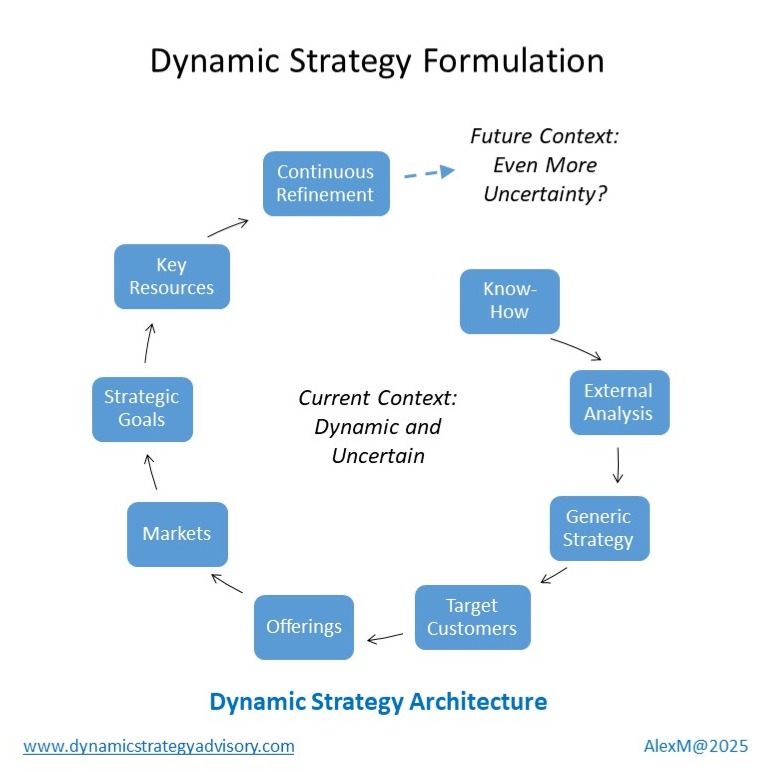
    The evolving nature of the Dynamic Strategy Formulation Methodology is visually represented in Figure 1, which depicts its nine steps as a spiral. This spiral symbolizes the methodology’s adaptability, illustrating how strategies evolve through time and continuously adjust to changing contexts, ensuring relevance and effectiveness in a dynamic environment.
    1. Know-How

    The objective of the first step is to define the organization’s core strengths and unique expertise, ensuring that all strategic choices build upon a solid foundation of sustainable competitive advantage and value creation. This turns into the following key questions that must be asked during the process: What is our know-how, and do we possess any competitive advantages? Are they sustainable? How can we create value for both our customers and ourselves, including innovative value?

    This step aligns closely with VRIO Analysis, which evaluates resources and capabilities based on their Value, Rarity, Imitability, and Organizational support. It also directly corresponds to the ‘Required Capabilities’ stage of the Playing to Win Strategy Cascade, as both focus on identifying and analyzing an organization’s strengths. While the ‘Winning Aspiration’ and ‘How to Win’ stages of the Cascade are indirectly linked, they rely on leveraging know-how to define the organization’s purpose and strategic positioning.

    In the following example, the question ‘What is their know-how?’ reveals that Apple’s know-how lies in its design and innovation capabilities, specifically its ability to seamlessly integrate hardware and software. Do they possess competitive advantages? Yes, this integration, combined with user-centric design, creates a unique ecosystem. Are these advantages sustainable? Apple continually invests in R&D focusing on proprietary chips and supply chain control, and cultivates a strong brand image, making their advantages difficult to imitate. The question “How can they create innovative value?“ is reflected in its expansion into services such as the App Store, iCloud, and Apple Pay – leveraging existing expertise into new, high-margin opportunities. This systematic questioning reveals how Apple’s core competencies translate into tangible market success. This highlights how strategically asking these questions leads to identifying and leveraging core strengths, rather than simply stating them.

    2. External Analysis

    The objective of the second step is to assess external forces that influence the organization’s success, identify emerging opportunities, and potential threats to align the strategy with broader market dynamics and uncover new market spaces by recognizing non-customers and latent demand. This brings us to the key questions we need to ask along the way: What external opportunities and threats should we consider to align our strategy with the broader market dynamics? Can we uncover new market spaces among non-customers and latent demand?

    This step corresponds with Porter’s Five Forces, which examines industry dynamics and helps organizations evaluate competitive pressures and market attractiveness. It also resonates with Blue Ocean Strategy, which emphasizes identifying untapped market spaces and creating new demand. Additionally, it aligns with SWOT Analysis, which supports mapping external opportunities and threats in relation to internal strengths and weaknesses.

    In this example, the core questions help a company anticipate shifts in the competitive landscape. What external opportunities and threats should we consider? Netflix identified the opportunity created by rising internet speeds, digital streaming technology, and shifting consumer preferences toward on-demand content while recognizing threats such as the decline of DVD rentals and intensifying competition. Can we uncover new market spaces? Netflix pioneered subscription-based streaming, tapping into latent demand for on-demand, personalized entertainment. It attracted a vast audience of “non-customers” dissatisfied with traditional television, creating a Blue Ocean by eliminating physical rentals and offering personalized recommendations. This structured analysis demonstrates how Netflix’s strategic pivot was driven by a deep understanding of external forces, allowing it to seize emerging trends and shape a new market.

    3. Generic Strategy

    The objective of the third step is to define the organization’s competitive approach to guide the organization’s resource allocation and market positioning, whether through low-cost leadership, differentiation, focus strategy, or an innovative alternative. Therefore, the process requires us to consider these key questions: What will our generic strategy be: low-cost leadership, differentiation, a focus strategy targeting specific market segments, or some innovative approach? Will we adopt an industry-wide or niche approach?

    This step aligns directly with Porter’s Generic Strategies, a framework that offers a clear method for choosing competitive approaches. The alignment with Blue Ocean Strategy complements this by encouraging innovative positioning beyond traditional competitive boundaries. Finally, the Playing to Win Strategy Cascade aligns through its How to Win component, as both focus on defining the organization’s competitive advantage. Whether the approach is differentiation, cost leadership, or innovation, this decision shapes the foundation for competitive positioning.

    By addressing the question ‘What will our generic strategy be?’ we discover that IKEA employs a cost leadership strategy. This is achieved by making stylish furniture accessible to a broad audience through flat-pack designs, standardized production, and an efficient global supply chain. Will we adopt an industry-wide or niche approach? IKEA competes industry-wide, targeting mass-market consumers with its broad range of products rather than a niche segment. This choice drives economies of scale and reinforces its cost advantage. The strategic questioning process clarifies how IKEA’s cost leadership is not just about low prices – it is a carefully structured approach that aligns design, logistics, and retail experience to create value for customers while maintaining profitability.

    4. Target Customers

    The objective of the fourth step is to identify customer segments and their specific needs to ensure alignment with the organization’s strategy, maximizing market impact and positioning. This leads to the formulation of the following key question: Which customer segments do we want to target, and what specific needs will we aim to fulfill?

    This step directly aligns with the Value Proposition Canvas, which emphasizes understanding customer needs, segmenting customers, and delivering tailored solutions. It also corresponds with the Ansoff Matrix, which supports identifying growth opportunities in existing or new customer segments. Blue Ocean Strategy aligns with Target Customers by encouraging organizations to look beyond current customer bases and identify new or underserved segments. By addressing latent demand and exploring non-customers, the methodology supports the creation of innovative value propositions tailored to these emerging opportunities. Finally, there is some overlap with Where to Play in the Playing to Win Strategy Cascade, which includes customer segments but has a broader scope, encompassing market, geographic, and product category choices.

    Answering ‘Which customer segments do we want to target?’ reveals that Tesla focuses on environmentally conscious, tech-savvy consumers seeking high-performance electric vehicles. This question pushes a company beyond analyzing basic demographics, requiring an analysis of psychographics and behavioral patterns. What specific needs will we aim to fulfill? Tesla identified a gap in the market – early EVs often compromised on performance, design, or range. By addressing these concerns with cutting-edge battery technology, sleek design, superior acceleration, autonomous driving features, and over-the-air software updates Tesla attracted not only sustainability-focused buyers but also performance enthusiasts. This structured approach to defining target customers allowed Tesla to position itself as more than just an EV company – it became a status symbol and a leader in automotive innovation.

    5. Offerings

    The objective of the fifth step is to define the products and services that effectively meet customer needs, ensuring customer satisfaction, value creation, and sustainable growth. It poses a key question: What products and services should we offer to meet those customer needs effectively?

    This step aligns directly with the Value Proposition Canvas, emphasizing the alignment of products and services with customer needs through tailored solutions. It also aligns with VRIO Analysis, ensuring offerings leverage the organization’s unique capabilities, and with Blue Ocean Strategy, which focuses on crafting groundbreaking, innovative offerings to unlock new markets. Additionally, ‘Offerings’ corresponds with the product development dimension of the Ansoff Matrix, guiding the development of products or services for existing markets as a growth pathway. Finally, it aligns with the Playing to Win Strategy Cascade, linking the purpose of offerings to the company’s broader strategic goals (Winning Aspiration) and competitive positioning (How to Win).

    The question ‘What products and services should we offer?’ would have guided Amazon to identify, as they ultimately did, that their customers prioritize convenience, speed, and a seamless shopping experience. Instead of offering just fast shipping, the company created Amazon Prime – a subscription that bundles free one-day delivery, exclusive content, and additional services. This question pushes a company to think beyond single products, and to consider the entire customer experience. How does this effectively meet customer needs? Prime solves multiple pain points: it eliminates delivery delays, provides access to entertainment, and offers shopping benefits, strengthening customer loyalty. By consistently adding value and anticipating evolving customer preferences, Amazon has transformed Prime from a simple delivery service into a comprehensive ecosystem that fosters deep customer loyalty and drives recurring revenue. This systematic questioning process ensures that offerings are thoughtfully designed to enhance customer satisfaction, build stronger relationships, and drive growth. It highlights how asking the right questions about offerings can lead to innovative and effective solutions.

    6. Markets

    The objective of the sixth step is to identify the most strategic locations and markets for operations and competition, ensuring optimal resource allocation and value capture. The question is: In which locations or markets do we want to operate and compete?

    This step aligns with the Ansoff Matrix, which provides guidance on market development strategies. It also corresponds with Porter’s Five Forces, which aids in evaluating market attractiveness and understanding competitive dynamics. Additionally, it connects with the “Where to Play” dimension of the Playing to Win Strategy Cascade, offering a framework for selecting specific markets or geographies to compete in. Lastly, it resonates with Blue Ocean Strategy, which encourages the exploration of unconventional or untapped market spaces, fostering innovation in market entry strategies.

    The core question of this step, ‘In which locations or markets do we want to operate?’ guided Starbucks in building its global presence by expanding into high-growth international markets while carefully adapting to local cultures. Instead of a one-size-fits-all approach, Starbucks tailors its store designs, marketing campaigns, and product offerings to regional preferences – introducing matcha lattes in Japan, dulce de leche frappuccinos in Latin America, and kaya toast sets in Singapore. How does this optimize market impact? By blending global brand identity with local relevance, Starbucks has strengthened customer loyalty and differentiated itself from competitors. This strategic questioning ensures that market selection is deliberate, aligned with the company’s capacity to deliver value across diverse regions, and positioned to maximize competitive advantage and sustainable growth.

    7. Strategic Goals

    The objective of the seventh step is to establish clear, measurable goals that provide direction, create accountability, and ensure progress toward strategic success. This transforms into the critical question that guides the process: What measurable strategic goals will guide our efforts and define success?

    This step aligns with the Balanced Scorecard, which translates strategic goals into actionable metrics across multiple perspectives. It also aligns with the Playing to Win Strategy Cascade, emphasizing the definition of aspirations and their linkage to measurable outcomes.

    Unilever provides an example of a company successfully answering ‘What measurable strategic goals will guide our efforts?’ The company has embedded sustainability at the heart of its strategy, setting ambitious targets such as halving its environmental footprint and sourcing 100% of its agricultural raw materials sustainably by 2030. This question compels companies to move beyond vague aspirations and define specific, quantifiable targets. How does this drive strategic success? By setting clear sustainability metrics, Unilever aligns its environmental commitment with cost efficiency, product innovation, and stakeholder expectations. These goals also fuel innovation in sustainable practices – developing concentrated detergents to reduce packaging waste and investing in renewable energy to power operations. By defining and pursuing measurable goals, Unilever has strengthened its reputation, attracted environmentally conscious consumers, and achieved cost savings through resource efficiency. This structured approach transforms sustainability from a corporate statement into a measurable driver of competitive advantage, demonstrating how well-defined goals create focus, accountability, and long-term impact.

    8. Key Resources

    The objective of the eighth step is to identify, align and allocate efficiently the necessary assets, human resources, knowledge, and technology to successfully execute the strategy. This results in the following key questions we should explore during the process: What assets, human resources, knowledge, and technology are required to achieve this strategy? What resources need to be resized, relocated, or otherwise adjusted to align with our goals?

    This step finds direct alignment with the Playing to Win Strategy Cascade, specifically its ‘Required Capabilities’ component. This dimension emphasizes the development and alignment of the right capabilities in place, ensuring the organization can deliver on its strategic decisions by securing critical assets, skills, and technologies. Furthermore, this step also aligns with the VRIO Framework, which assesses resources against their Value, Rarity, Imitability, and Organizational support to ascertain their potential for creating a lasting competitive advantage.

    The core questions of this step guided Intel in strategically allocating and developing its resources. What assets, human resources, knowledge, and technology are required? In early 2022, Intel, recognizing the strategic importance of semiconductor production, committed $20 billion to building two advanced fabrication plants in Ohio. This decision, made amid global supply chain disruptions and geopolitical uncertainties, aimed to reposition Intel’s resource base to enhance control over its value chain, reduce geopolitical risks, and meet the anticipated rising demand for domestically produced semiconductors. What resources need to be resized, relocated, or otherwise adjusted? Beyond expanding manufacturing capacity, Intel needed to secure skilled talent, invest in cutting-edge chip-making technology available at the time, and strengthen supply chain resilience. The company sought to align its resources with long-term strategic priorities to reinforce its market position, sustain innovation, and support national technological leadership. This systematic questioning ensures that resource allocation is directly aligned with strategic goals, enabling efficient execution and sustainable growth. However, evolving market dynamics and rapid advancements in AI chip technology have reshaped the industry’s competitive landscape since Intel’s move, with Nvidia emerging as the leader by early 2025.

    9. Continuous Refinement

    The objective of the ninth and final step is to establish a process for ongoing monitoring, evaluation, and adaptation of the strategy, ensuring continued relevance and responsiveness to evolving market dynamics. This leads to the following key question that must be asked: How will we monitor, evaluate, and refine our strategy over time to address declining relevance and pivot toward new opportunities?

    This step aligns with Blue Ocean Strategy, which emphasizes reassessing assumptions and uncovering new value creation opportunities – whether by identifying untapped markets or redefining existing ones in response to shifting strategic conditions. It also aligns with SWOT Analysis, which facilitates continuous evaluation of internal and external factors to refine strategic direction.

    IBM is an example of a company that has successfully used such questions to continuously monitor its operating environment and adapt its strategy accordingly. How will we monitor, evaluate, and refine our strategy over time? IBM implemented a system for tracking market trends, customer feedback, and technological advancements to identify emerging opportunities and potential threats. Once a dominant player in hardware manufacturing, IBM recognized the declining relevance of its legacy business amid shifting industry dynamics. How did IBM pivot toward new opportunities? IBM strategically divested its hardware business and invested heavily in cloud computing and AI, acquiring companies with relevant expertise and developing new service offerings. This iterative approach to strategy refinement allowed IBM to reinvent itself and remain competitive in a rapidly changing technology landscape. This systematic questioning ensures that strategy remains dynamic and adaptable, allowing organizations to respond to shifting circumstances and seize emerging opportunities.

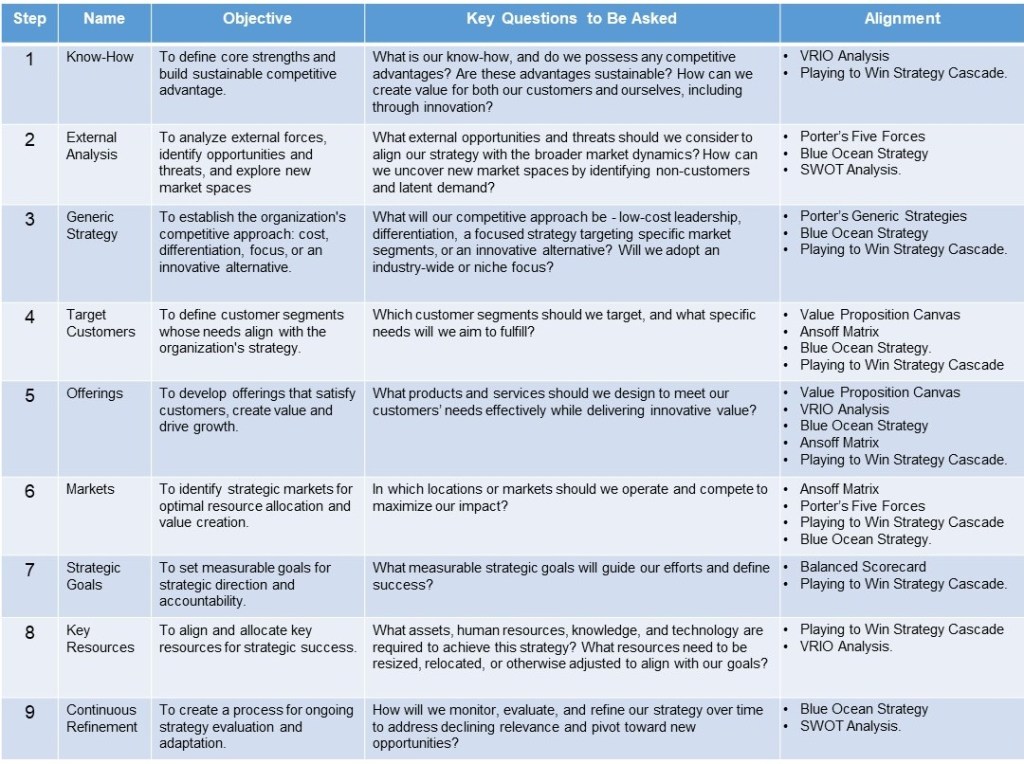
    With the nine steps of the Dynamic Strategy Formulation Methodology now outlined, the next chapter explores the key advantages of this methodology, showing how it helps strategists move beyond isolated frameworks and equips them with a powerful tool to navigate today’s complex and uncertain business environment. For a concise overview of each step, including its objective, key questions, and framework alignment, please refer to Table 1.
    A Strategist’s Toolkit: An Integrated and Actionable Approach

    The Dynamic Strategy Methodology offers a structured yet flexible framework that integrates key strategy models into a practical, cohesive, end-to-end process. Unlike models that focus solely on competition (Porter’s Five Forces) or resource allocation (VRIO), this methodology ensures comprehensive coverage of all critical aspects of strategy formulation, presented in a logical and sequential manner.

    A key advantage of this methodology lies in its dynamic nature. It is not a static blueprint but a living framework, enabling strategists to revisit and refine steps based on new insights, evolving market conditions, or execution challenges. This methodology guides strategists through a clear progression of questions that drive concrete choices rather than abstract analysis. Furthermore, the questions are designed to stimulate creative thinking, encouraging innovation and the development of unique value propositions.

    Organizations often struggle to bridge the gap between strategy formulation and execution. This methodology actively addresses this challenge by compelling organizations to consider alignment – not just as an abstract concept, but in terms of identifying and aligning key resources, establishing measurable strategic goals, and implementing a process for continuous refinement. This ensures that strategy translates seamlessly into action, driving tangible results.

    Conclusion

    In an era defined by rapid change and unprecedented uncertainty, the ability to formulate dynamic and adaptable strategies is paramount. This article introduced the Dynamic Strategy Formulation Methodology, a structured, nine-step approach designed to bridge the gap between strategic theory and practical application. By integrating key insights from established frameworks into a cohesive, end-to-end process, this methodology empowers organizations to move beyond isolated strategic elements and develop strategies that are both responsive and innovative.

    The methodology’s emphasis on continuous refinement and its focus on actionable questions provides strategists with a practical toolkit for navigating complex market dynamics. By offering a systematic approach to strategy formulation, this methodology aims to enhance strategic agility and drive sustainable growth.

    Looking ahead, the next frontier lies in further testing and refining this methodology across different industries and organizational contexts. However, the most transformative opportunity may be exploring the role of artificial intelligence in enhancing each step of the process. Can AI streamline and optimize strategic formulation to the point where the human role is limited to making critical choices? Or could AI eventually take over the process entirely, reducing the human role even further? While this evolution holds promise, it also raises critical questions about risks, oversight, and the potential loss of human intuition in strategic thinking.

    Ultimately, this methodology represents not just a solution for today’s challenges but also a foundation for navigating tomorrow’s uncertainties. As businesses continue to evolve, so too must the tools and approaches they rely on to shape their future.

    REFERENCES:

    ANSOFF, H. I. (1957). Strategies for Diversification. Harvard Business Review, 35(5), 113–124.

    BARNEY, J. B. (1991). Firm Resources and Sustained Competitive Advantage. Journal of Management, 17(1), 99–120.

    HENDERSON, B. (1970). The Product Portfolio. Boston Consulting Group Perspectives, 66.

    KAPLAN, R. S., & NORTON, D. P. (1992). The Balanced Scorecard – Measures That Drive Performance. Harvard Business Review, 70(1), 71–79.

    KIM, W. C., & MAUBORGNE, R. (2005). Blue Ocean Strategy: How to Create Uncontested Market Space and Make the Competition Irrelevant. Harvard Business Review Press.

    LAFLEY, A. G., & MARTIN, R. (2013). Playing to Win: How Strategy Really Works. Harvard Business Review Press.

    LEARNED, E. P. et al (1965). Business Policy: Text and Cases. Irwin.

    MILOVANOVICH, A (2024). Strategic Management in the 21st Century. Self-published.

    OSTERWALDER, A. et al (2014). Value Proposition Design: How to Create Products and Services Customers Want. Wiley.

    PORTER, M. E. (1979). How competitive forces shape strategy. Harvard Business Review, 57(2), 137-145. PORTER, M. E. (1980). Competitive Strategy: Techniques for Analyzing Industries and Competitors. Free Press.
  • Mastering Execution in the Age of AI and UncertaintyHow 8 Interconnected Competencies Turn Ambition into Reality

    Mastering Execution in the Age of AI and UncertaintyHow 8 Interconnected Competencies Turn Ambition into Reality

    The Gap between Strategy and Results

    Despite the effort and ambition behind strategic planning, most business strategies fail to deliver. Multiple studies estimate that between 60% and 90% of strategic plans never fully launch or achieve their intended outcomes. While the reasons vary – from volatile market dynamics to internal misalignment – execution remains the most persistent and cited point of failure. Reinforcing this, a recent Gartner study found that only 43% of executives believe their organizations are highly effective at evaluating their capacity to execute strategy (Kumar, 2025).

    Worse, the underlying problem is systemic: traditional execution models are too rigid for today’s volatile, uncertain, complex, and ambiguous (VUCA) environment. These legacy frameworks assume strategy flows linearly – from formulation to implementation – ignoring the feedback loops and agility needed to respond to emerging disruptions. Most models don’t integrate human machine collaboration, real time risk sensing, or iterative adaptation. Instead, execution becomes static – disconnected from learning, slow to pivot, and detached from the evolving reality organizations operate in.

    This article introduces a modern execution framework built for strategic adaptability. Rooted in my earlier work on the Dynamic Strategy Map – specifically its seventh step, Adaptive Execution – this framework presents a system of eight interconnected competencies that form the core of execution excellence (Milovanovich, 2025). These competencies are designed to embed coherence, responsiveness, and continuous learning into the fabric of execution. They enable organizations to operate as dynamic systems – capable of sensing change, orienting quickly, making informed decisions, and acting with precision. In short, this framework transforms execution from a mechanical process into a strategic capability, aligned with the complexities of the modern age.

    The Evolution of Strategic Execution

    For decades, scholars and practitioners have dissected why strategies fail – and what separates organizations that plan from those that deliver. The consensus is clear: execution is not an afterthought but a system of interdependent organizational strengths. When discussed together, these strengths form the backbone of successful execution.

    The evidence reveals a compelling history of thought on this topic. Gary Hamel and C.K. Prahalad (1990) were among the first to emphasize that execution strength originates from core competencies – deeply embedded organizational know-how rooted in the collective learning and coordination of diverse skills and technologies.

    Peter Drucker’s timeless distinction between doing things right and doing the right things – adapted from his writings on efficiency and effectiveness – underscores that setting direction and building an effective organization are essential to making strategy work (Drucker, 1963; Drucker, 1974). Lawrence Hrebiniak amplifies this, showing that culture and structure are execution’s make-or-break factors. He argued that process discipline and cross-functional alignment often falter because execution is treated as a technical challenge rather than a leadership imperative (Hrebiniak, 2005). Larry Bossidy and Ram Charan (2002) take it further, framing execution as a discipline in its own right – one where leaders must “own” the connection between people, processes, and financial rigor.

    In today’s complex, data-rich environment, researchers have underscored the need for new organizational competencies. Douglas Laney (2017), along with Thomas Davenport and Jeanne Harris (2007), pioneered the view of information as a strategic asset – demonstrating how timely, actionable data can sharpen execution by enabling organizations to sense change, orient decisions, and act with precision. Building on this foundation, Paul Daugherty and James Wilson (2018) highlight the essential synergy between human judgment and technology, arguing that AI should augment – not replace – human capabilities.

    This interplay between data and human insight demands organizational agility. Stéphane Girod and Martin Králik (2021) advocate for adaptive systems – spanning responsive finance, dynamic risk management, and proactive leadership – that can thrive amid uncertainty. Their perspective aligns with Jim DeLoach’s call to embed risk management into strategic thinking, not only to bolster resilience but also to surface new opportunities (DeLoach, 2017).

    Ultimately, the success of this paradigm hinges on leadership. John Kotter’s seminal work reminds us that execution is change – a process requiring urgency, coalition-building, and clear communication (Kotter, 1996). William Joiner and Stephen Josephs (2007) extend this view with insights on leadership agility, showing that even the most robust strategies falter without leaders who can adapt, learn, and lead through complexity.

    Today’s environment also demands ongoing learning and adaptation, including the continuous refinement of Objectives and Key Results (OKR), feedback integration, and iteration, as outlined in my recent work on adaptive execution (Milovanovich, 2025).

    These authors, spanning different eras and specializations, all arrive at the same conclusion: successful execution depends on an integrated set of human and systemic competencies that organizations must intentionally develop and coordinate.

    The Strategy Execution Engine – A System of Competencies in Motion

    A brilliant symphony is worthless without the instruments to play it. Likewise, a stunning strategy is useless without the execution muscle to realize it.

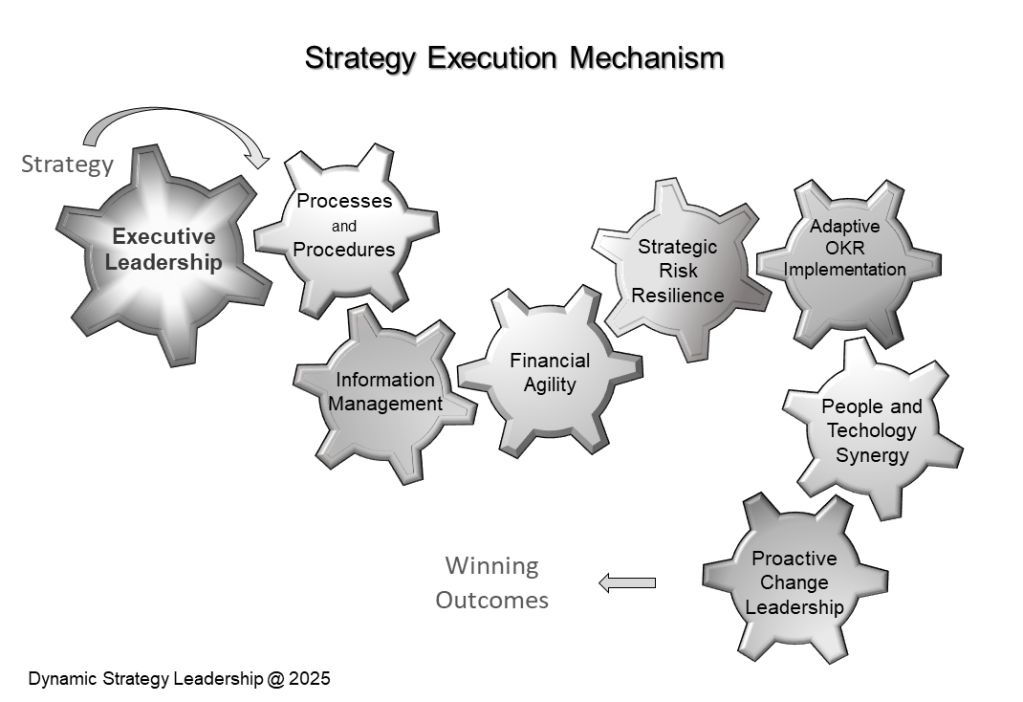
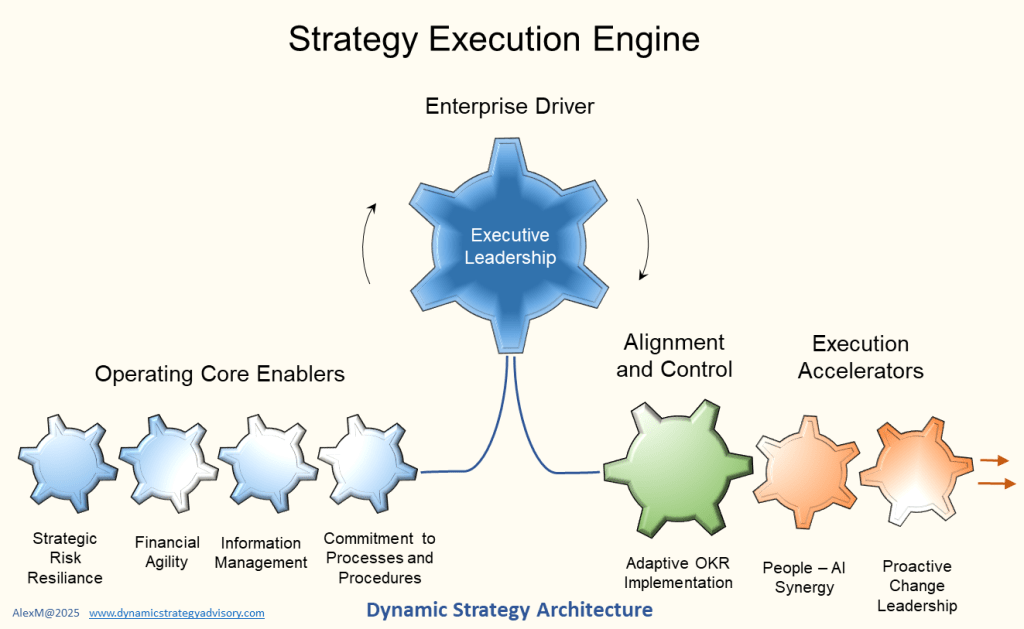
    Most organizations know what they want to achieve, and many know how to start – but few possess a complete, integrated framework to keep execution moving at full power. This is why so many promising strategies stall or fade. To bridge this gap, I introduce the Strategy Execution Engine – a leadership-driven framework composed of eight core competencies. Leaders can use their own execution strength to activate and align the other seven, creating momentum across the organization.

    The framework is organized into four functional sets:

    I Enterprise Driver

    At the heart of the system is Executive Leadership – the primary force that sets direction, drives accountability, and energizes the entire execution effort. It is the central competency that activates and sustains the rest.

    II Operating Core Enablers

    These four competencies form the foundation upon which execution rests:

    • Commitment to Processes and Procedures
    • Information Management
    • Financial Agility
    • Strategic Risk Resilience

    Together, they build the organizational infrastructure needed to support strategic adaptability and operational excellence.

    III Alignment & Control

    This set contains a single but pivotal competency:

    • Adaptive OKR Implementation

    It ensures that all components of the system remain synchronized with strategic goals, adapting in real time to changing conditions and feedback.

    IV Execution Accelerators

    These two competencies energize and deliver outcomes:

    • People–AI Synergy
    • Proactive Change Leadership

    They represent the direct actions and behaviors that translate strategy into reality, enabling organizations to move with speed, clarity, and resilience.

    This Strategy Execution Engine is not a static model – it is a living system. Its power lies in its coherence, adaptability, and the ability of leaders to orchestrate its movement. The objective is not to perfect each competency in isolation but to cultivate a cohesive, adaptive whole – one in which leadership continuously drives, aligns, and energizes the engine. In the chapters ahead, we will explore each competency in depth, revealing how organizations can build the execution muscle required to deliver on their strategic promise.

    The Eight Competencies of Execution Excellence

    The following sections provide a detailed look at each of the eight competencies that form the Strategy Execution Engine, starting with the foundational driver.

    1. Executive Leadership

    At the heart of any effective strategy execution engine lies Executive Leadership – not a lone hero, but a cohesive, aligned team of leaders who serve as both strategists and execution drivers. While a strong CEO is indispensable, excellence comes when the entire C-suite moves as one – reflecting shared values, inspired direction, and tight collaboration. The CEO shapes culture, exemplifies integrity, and sets the tone – but must also assemble and motivate an executive team that reinforces the strategy across the organization.

    A prime example is Alan Mulally’s tenure as CEO of Ford. When he took the helm in 2006, the company’s executive team was notoriously siloed and dysfunctional. Mulally didn’t simply impose a new strategy; he instituted a weekly Business Plan Review meeting where every senior leader was required to share progress, challenges, and concerns with complete transparency. This disciplined, uniform metrics-driven forum dismantled barriers, built trust, and fostered a culture of collaboration and shared accountability. By uniting the leadership team around the “One Ford” plan, Mulally transformed the company’s trajectory – moving from a $12.7 billion loss in 2006 to a $6.6 billion reported profit by 2010 – without accepting the government bailouts that competitors relied on during the financial crisis.

    Execution begins at the top – but it succeeds only when leadership becomes a system, not a personality.

    2. Commitment to Processes & Procedures

    Strategy fails when execution relies on improvisation. Organizations that institutionalize process discipline turn strategic intent into repeatable, scalable action. This demands leadership’s explicit commitment to designing and institutionalizing workflows that mirror priorities, ensuring teams operate from the same playbook.

    A contemporary example of this principle in action is Zara, the fast-fashion leader. Through a tightly integrated system, from design to production to store delivery, Zara transforms runway inspiration into retail inventory in just two to three weeks. It combines just-in-time inventory, real-time data feedback, in-house manufacturing, and workflows tied to daily Point of Sale data. Store managers report sales trends and customer feedback directly to designers, enabling rapid redesign and replenishment. As a result, Zara maintains minimal stock, responds swiftly to demand, and minimizes waste – all powered by disciplined, company-wide process orientation.

    Process excellence isn’t bureaucracy – it’s the scaffolding for reliable execution. Companies that neglect this, as WeWork did by prioritizing aggressive expansion over financial controls and sound governance, waste resources and erode trust. WeWork’s unchecked leadership, opaque decision-making, and unsustainable growth model led to a failed IPO and eventual bankruptcy restructuring – a cautionary tale in execution without discipline.

    When integrated with an agile framework, process discipline creates a self-correcting system where deviations trigger immediate adjustments rather than cascading failures.

    3. Information Management

    Timely, accurate, and actionable information fuels adaptive execution. It powers decision-making across all competencies – from process discipline to risk resilience – by enabling leaders to sense change, orient decisions, and act with precision. Information Management (IM) is not just a technical function; it’s a strategic capability encompassing how organizations create, collect, process, analyze, store, retrieve, and use information across people, processes, technology, and content.

    In the AI era, IM must be designed to support a 24/7, globally distributed execution engine. Systems must be built around the needs of all users – employees, customers, partners, and increasingly AI agents – delivering real-time insights that drive agility, coordination, and autonomous action.

    A compelling example is Mars Inc., which partnered with Celonis to deploy AI-powered process mining across its supply chain. By analyzing vast operational data, Mars identified inefficiencies in truck loading and proactively consolidated shipments – reducing costs, improving delivery speed, and enhancing sustainability. This illustrates how intelligent IM systems can elevate execution by turning raw data into strategic action.

    Information Management is no longer about storage – it’s about strategic enablement. When integrated into the execution engine, it becomes the nervous system of the organization, sensing disruptions and enabling rapid, informed response.

    4. Financial Agility

    In an era of volatility, financial agility is essential to adaptive execution. It empowers organizations to respond to trade policy disruptions, interest rate uncertainty, and shifting customer behaviors with speed and precision. Agile financial management leverages digital technologies – AI, blockchain, and cloud platforms – to optimize working capital, enhance cash flow, and support dynamic decision-making.

    This competency spans budgeting, forecasting, scenario planning, risk management, and strategic communication. It must be both flexible and resilient – able to reallocate resources, adjust forecasts, and trigger cross-functional action in real time.

    Maersk, the global logistics leader, exemplifies how financial agility can be embedded into enterprise strategy. As part of its transformation into an end-to-end supply chain integrator, Maersk reengineered its financial planning and analysis capabilities using SAP S/4HANA Cloud ERP and SAP Analytics Cloud. This shift enables:

    •     Real-time financial forecasting across complex, multi-market operations

    •     Integrated planning and budgeting aligned with strategic objectives

    •     Automated decision support for capital allocation and risk management

    •     Scalable architecture that fuels continuous innovation and platform expansion

    Maersk’s finance transformation is not just a technology upgrade – it’s a strategic enabler that aligns financial agility with enterprise-wide adaptability. By embedding finance into its digital platforms, Maersk ensures that every business decision is grounded in timely, trustworthy data.

    5. Strategic Risk Resilience

    Strategic risk resilience goes beyond threat mitigation – it builds adaptive capacity. It enables organizations to anticipate disruptions, safeguard assets, and turn uncertainty into opportunity. This competency requires identifying, evaluating, and managing risks across operations, while setting clear tolerance thresholds to guide decisions under uncertainty.

    In the AI age, resilience demands a formal process for real-time monitoring and swift response. This requires fast, precise data analysis to act before risks materialize. AI is pivotal here, recognizing patterns, generating scenario models, and issuing predictive alerts that inform strategic choices.

    A compelling example of this is Siemens, which leverages AI-driven risk monitoring to enhance supply chain resilience. Instead of reacting to disruptions like component shortages, manufacturing bottlenecks, or extreme weather, their AI-driven “digital twin” of the supply chain continuously models both internal and external factors. This allows Siemens to run extensive simulations of supply chain processes, proactively identifying vulnerabilities and simulating alternative sourcing and logistics plans without disrupting physical operations. The approach ensures operational continuity and supports an adaptive execution engine even in prolonged uncertainty.

    Strategic risk resilience is not a defensive posture – it’s a dynamic capability embedded in the execution engine. When done right, it transforms uncertainty into foresight and volatility into opportunity.

    6. Adaptive OKR Implementation

    Adaptive OKRs translate strategic goals into ambitious, time-bound objectives and measurable key results that resonate with teams and individuals who own them. This competency ensures that execution remains focused, accountable, and responsive to change. Effective implementation includes setting quantitative outcomes, tracking progress regularly, and refining goals based on performance insights and environmental shifts.

    In the AI age, OKRs must evolve from static goal-setting tools into dynamic execution drivers. Best practices include real-time technology integration, AI-enhanced analytics, cross-functional collaboration, and employee empowerment through transparency, innovation, and recognition.

    Adobe‘s Digital Imaging organization adopted an AI-powered solution from Quantive to revolutionize its OKR implementation. The system moved them from managing goals manually with spreadsheets to a dynamic, data-driven framework. By automating the collection of metrics, the AI provided real-time, transparent progress updates. This not only liberated employees from tedious, administrative tasks but also significantly elevated data trust and fostered greater strategic alignment and velocity across the organization’s diverse product teams.

    Adaptive OKRs are not just a framework – they’re the rhythm of the execution engine. When powered by intelligent systems and embedded into culture, they enable organizations to stay focused, learn continuously, and adapt with precision.

    7. People-AI Synergy

    In the AI era, strategy execution is powered by the synergy between human judgment and machine intelligence. People–AI synergy fuels learning, productivity, creativity, and innovation – making it a core competency for adaptive execution. It must be designed to support autonomy, collaboration, and knowledge sharing across all work models, including hybrid and distributed teams.

    Modern management control systems must evolve beyond traditional oversight. They must enable humans and AI agents to work in tandem – delegating tasks, surfacing insights, and co-producing decisions. These systems should incentivize adaptability, continuous learning, and innovation, while preserving human authority in complex or ambiguous contexts.

    Intel exemplifies this transformation. To manage over 19,000 suppliers, Intel built an AI-augmented system that analyzes structured and unstructured data to assess risk, optimize sourcing, and flag disruptions. Crucially, human experts remain embedded in the loop – interpreting signals, validating decisions, and refining AI outputs. The system integrates dashboards, predictive alerts, and collaborative workflows across procurement, compliance, and strategy teams.

    Intel’s approach demonstrates that People–AI synergy is not a technical overlay – it’s a strategic architecture. When embedded into the execution engine, it enables organizations to scale intelligence, enhance resilience, and unlock performance across every layer of the enterprise.

    8. Proactive Change Leadership

    In adaptive execution, change isn’t episodic – it’s continuous. Boards don’t manage change; they architect cultures that thrive on it. Proactive change leadership is a strategic competency that enables organizations to anticipate disruption, overcome resistance, and mobilize people and AI systems toward shared transformation goals.

    At its core, this competency involves identifying resistance points, guide personalized messaging with clarity and purpose, and engaging employees from the design stage to foster ownership, accountability, and learning. AI can enhance this process by analyzing sentiment, surfacing friction zones, and tailoring interventions to team dynamics.

    A compelling example comes from IBM, which deployed its AI-driven platform (Watson Works) during pandemic-era workplace transitions. The platform analyzed employee sentiment and productivity data in real time to inform workspace policies and hybrid work models. This enabled tailored communications and phased reopening strategies, reducing resistance and boosting engagement – delivering up to a 20% increase in employee engagement and 30% lower resistance to change. Demonstrating how AI can accelerate cultural readiness, IBM shows how organizations can embed adaptability at scale. Proactive change leadership is not about managing transitions – it’s about enabling perpetual adaptability. When embedded into the execution engine, it transforms change from a threat into a capability.

    Conclusion: Building the Execution Muscle for a VUCA World

    In an era of relentless volatility, uncertainty, complexity, and ambiguity (VUCA), a brilliant strategy is no longer enough. Organizations fail not for lack of vision, but for lack of a robust execution engine – the integrated, adaptive system that turns ambition into outcome. This engine, powered by the eight competencies we have explored, provides the adaptability needed to navigate a dynamic environment.

    Traditional, rigid execution models are obsolete. The future belongs to organizations that fuse human ingenuity with AI’s analytical power, creating a self-correcting system that thrives on continuous learning, responsiveness and change. This is not a one-time initiative but a cultural and operational transformation that demands leadership commitment and systemic investment.

    The statistics on execution failure are stark, but they are not inevitable. By architecting an organization where strategy and operations dynamically interact through a cohesive set of competencies, leaders can finally bridge the costly gap between planning and results. The execution engine is your ultimate competitive advantage – the disciplined, agile force that delivers today while adapting for tomorrow.

    REFERENCES:

    Bossidy, L. & Charan, R. (2002). Execution: The discipline of getting things done. Crown Business.

    Daugherty, P.R., & Wilson, H.J. (2018). Human + machine: Reimagining work in the age of AI. Harvard Business Review Press.

    Davenport, T. H., & Harris, J. G. (2007). Competing on Analytics: The New Science of Winning. Harvard Business Review Press.

    DeLoach, J. M. (2017). The art of strategic risk: A game plan for executives. Palgrave Macmillan.

    Drucker, P. F. (1963). Managing for Business Effectiveness. Harvard Business Review, 41(3), 53-60.

    Drucker, P. F. (1974). Management: Tasks, Responsibilities, Practices. New York, NY: Harper & Row.

    Girod, S.J.G., & Králik, M. (2021). Resetting management: Thrive with agility in the age of uncertainty. Kogan Page Ltd.

    Hamel, G. & Prahalad, C.K. (1990). The core competence of the corporation. Harvard Business Review, 68(3), 79–91.

    Hrebiniak, L.G. (2005). Making strategy work: Leading effective execution and change. Wharton School Publishing.

    Joiner, W.B. & Josephs, S.A. (2007). Leadership agility: Five levels of mastery for anticipating and initiating change. Jossey-Bass.

    Kotter, J.P. (1996). Leading change. Harvard Business Review Press.

    Kumar, S. Deliver on Your Strategy with 4 Key Actions: Improve strategic outcomes by expanding your view of what’s working and what isn’t. Gartner, July 10, 2025, http://www.gartner.com.

    Laney, D. (2017). Infonomics: How to monetize, manage, and measure information as an asset for competitive advantage. Bibliomotion.

    Milovanovich, A. Dynamic Strategy Map: Navigating Uncertainty with Real-Time Adaptation. The European Business Review, June 29, 2025, http://www.europeanbusinessreview.com

    Milovanovich, A. Evolving OKR Practices in Strategic Management for the Age of Uncertainty, Strategy Magazine (40), (Spring 2025) 28-31.

  • THRIVING IN THE 21ST CENTURY: EMBEDDING SUSTAINABILITY, SOCIAL RESPONSIBILITY, AND DIGITALIZATION INTO STRATEGY

    THRIVING IN THE 21ST CENTURY: EMBEDDING SUSTAINABILITY, SOCIAL RESPONSIBILITY, AND DIGITALIZATION INTO STRATEGY

    The contemporary world is witnessing an unprecedented convergence of challenges and opportunities. Mounting climate crises, worsening pollution, declining middle-class purchasing power, growing social inequality, persistent poverty, and global health crises threaten the fabric of societies and ecosystems. Economic instability, geopolitical fragmentation, and migration complexities further amplify uncertainty, shaping the landscape in which organizations operate. Stakeholders – from customers to regulators – are increasingly demanding corporate accountability for environmental and social impacts. Yet, many organizations continue to rely on strategies that fall short of addressing these pressing realities.

    Simultaneously, rapid advancements in digitalization and Artificial Intelligence (AI) have introduced transformative potential, reshaping industries and redefining the principles of competitiveness. In an increasingly digital world, the failure to integrate digital transformation and AI into strategic frameworks exposes organizations to significant competitive disadvantages.

    This article seeks to explore the imperative of crafting strategic frameworks that comprehensively address the pressing social, environmental, and technological challenges of the 21st century. It emphasizes the necessity of grounding strategies in a profound understanding of these prevailing issues, illustrating how organizations can navigate this complex landscape to ensure relevance, resilience, and sustainable growth.

    CRAFTING STRATEGIC INTENT IN A DYNAMIC WORLD

    The journey of any organization begins with fundamental choices – choices that define its very essence and chart its long-term course. These choices, encompassing what we traditionally call purpose, mission, and vision, are the bedrock upon which all strategic endeavors are built. However, in today’s relentlessly evolving landscape, these foundational elements cannot exist in a vacuum. They must be constantly tested and refined against the crucible of contemporary realities.

    The imperative for organizations to revisit and recalibrate their strategic frameworks has never been more urgent. To remain relevant and effective, a deep understanding of emerging challenges, evolving trends, and the complexities of our time is non-negotiable. The days of static, internally focused strategies are long gone.

    The contemporary business environment demands a new paradigm – one that seamlessly merges internal aspirations with external imperatives. We must move beyond rigid, siloed approaches and embrace inclusive strategic frameworks. These frameworks must strike a delicate balance between the enduring intent expressed through core choices and the agility required to navigate a world of constant change. This is not simply about adjusting to external pressures; it’s about embedding adaptability into the very DNA of the organization, ensuring that long-term vision and real-time responsiveness are inextricably linked.

    FORGING A RESILIENT FUTURE: THE THREE PILLARS OF STRATEGIC TRANSFORMATION

    The 21st-century business environment is defined by accelerating social inequality, environmental degradation, and technological disruption. Organizations must navigate a world where the lines between economic performance, social impact, and digital capability are increasingly intertwined. Traditional, profit-centric strategies no longer suffice – thriving in today’s complex reality requires a broader, more adaptive foundation.

    While financial performance remains essential, it is no longer the sole measure of success. Sustainable growth now depends on a company’s ability to address environmental and social responsibilities while harnessing the transformative power of digitalization. These three pillars – sustainability, social responsibility, and digitalization – are not standalone initiatives but interconnected forces that shape competitive advantage and long-term resilience.

    This integrated approach is not new in principle. In 1994, John Elkington introduced the Triple Bottom Line (TBL), advocating for businesses to balance profit with ecological and social well-being. Elkington’s insight remains relevant today: to succeed, organizations must embed these priorities into their strategic core – not as afterthoughts or compliance measures, but as essential drivers of value creation.

    We are not merely adapting to change; we are shaping the future. By embracing these three foundational pillars, we are forging a path towards a more sustainable, equitable, and prosperous world – a world where businesses thrive not at the expense of society and the environment, but in harmonious synergy with them.

    INTEGRATED SUSTAINABILITY

    In the 21st century, sustainability is no longer a peripheral concern – it is the foundation of lasting business success. A strategy that embeds sustainable value at its core not only meets ethical imperatives but also drives significant financial and operational gains. It’s about creating an enterprise built to thrive long-term, where ecological responsibility and economic prosperity are deeply interconnected.

    Consider the compelling financial argument. Bob Willard (2012), in “The New Sustainability Advantage”, paints a vivid picture: companies that embrace the Triple Bottom Line – people, planet, profit – aren’t just ethically sound; they’re financially formidable. Willard’s research suggests potential profit increases of 51% to 81% within five years, a testament to the power of integrating sustainability into strategic DNA. This surge isn’t just about cutting costs; it’s about unlocking new revenue streams, attracting top talent, and mitigating the very risks that can cripple a business.

    Think about it: increased market share from conscious consumers, reduced operational costs through resource efficiency, a highly engaged and innovative workforce attracted by a purpose-driven culture. These are not mere aspirations; they are tangible benefits. But the true power of sustainable value lies in its holistic approach. It’s about recognizing that a company’s success is intrinsically linked to the health of the communities in which it operates.

    Take Patagonia, for example. They haven’t just bolted sustainability onto their business model; they’ve built their entire strategy around it. Their mission, “We’re in business to save our home planet,” isn’t just a tagline; it’s a guiding principle that permeates every aspect of their operations. From their commitment to using recycled materials and reducing waste to their “Don’t Buy This Jacket” campaign, Patagonia demonstrates that authentic sustainability can drive both profitability and brand loyalty. They understand that their customers, and their employees, are drawn to a company that genuinely cares about the planet. They are not merely selling products; they are selling a set of values, and a future.

    Sustainable communities, like the ones Patagonia supports, are fertile ground for innovation and talent. When businesses prioritize environmental conservation, social equity, and economic prosperity, they create an ecosystem where individuals flourish. This, in turn, fosters a workforce that is not only skilled and motivated but deeply invested in the organization’s long-term success. They become the linchpin of resilience, a testament to the symbiotic relationship between human capital and sustainable growth.

    Embracing sustainable value isn’t just a smart business decision; it’s a strategic imperative. It’s about building a future where businesses thrive by creating a world that thrives.

    WEAVING SOCIAL RESPONSIBILITY into the HEART of ENTERPRISE

    Beyond the balance sheets and bottom lines lies the heart of enterprise: social responsibility. It’s not a mere addendum to strategy; it’s the very fabric that binds a company to its community and its future. True sustainability is unattainable without a deep commitment to fostering an equitable and flourishing world. This isn’t just about mitigating negative impacts; it’s about actively creating positive change, enriching the lives of those around us while pursuing economic objectives.

    Imagine a company that sees its success as intrinsically linked to the well-being of its communities and the health of the planet. This is the essence of social responsibility: a proactive, purposeful engagement that extends beyond compliance and philanthropy to encompass ethical sourcing, fair labor practices, diversity and inclusion, and a relentless pursuit of a reduced carbon footprint. It’s about empowering employees through volunteerism, supporting local initiatives, and building a legacy of positive impact.

    Consider Ben & Jerry’s. Their mission isn’t just to sell ice cream; it’s to create linked prosperity for everyone connected to their business. From sourcing Fairtrade ingredients to advocating for social justice issues, Ben & Jerry’s demonstrates that a company can be both profitable and deeply committed to social responsibility. They understand that their customers, and their employees, are drawn to a company that stands for something more than just profit. They use their business as a platform to drive social change, demonstrating that responsible business practices are not just good for society, they’re good for business.

    A shining example of social responsibility as a strategic cornerstone is Ben & Jerry’s, the iconic ice cream company. Since its inception, Ben & Jerry’s has championed social justice, environmental protection, and sustainable food systems. Its “Justice ReMix’d” initiative, aimed at reforming criminal justice systems, exemplifies its commitment to societal impact. The company also supports Fairtrade practices and partners with social equality groups, ensuring its operations align with its values. This unwavering dedication to social responsibility has not only solidified Ben & Jerry’s reputation, drawing in customers and employees who value a company that stands for something more than profit, but has also contributed to its commercial success, demonstrating that doing good and doing well can go hand in hand.

    In a world increasingly driven by purpose, the pressure on companies to embrace social responsibility is mounting. Job seekers, consumers, suppliers, and investors are voting with their feet, actively seeking out organizations that align with their values. Companies that ignore their social and environmental responsibilities do so at their peril. They risk losing market share, alienating stakeholders, and ultimately, facing the very real threat of obsolescence.

    Social responsibility is not a cost; it’s an investment – an investment in a more just, equitable, and sustainable future. It’s about building a company that not only thrives but also contributes to the thriving of the world around it. It’s about recognizing that true success is measured not just in financial terms, but in the positive impact we leave behind.

    THE IMPERATIVE OF DIGITALIZATION

    In the modern business landscape, digitalization is no longer optional – it is the foundation of competitive advantage and long-term success. Companies that fully integrate digital technologies into their strategies are not merely adapting to change; they are shaping the future of their industries. From cloud computing and data analytics to Artificial Intelligence (AI) and Generative AI (GenAI), the digital revolution is redefining how businesses operate, innovate, and create value.

    At its core, digital transformation is more than just adopting new tools – it is about reimagining business models, processes, and customer interactions. AI and GenAI, for example, are revolutionizing decision-making, automating complex tasks, and enabling hyper-personalized customer experiences at scale. Companies that fail to embrace these technologies risk being left behind, unable to keep pace with evolving market expectations and the efficiency of their digital-first competitors.

    A striking example of a company that built its strategy around digitalization is Siemens. Through its Siemens Xcelerator platform, the industrial giant has embraced AI, IoT, and digital twins to drive innovation across manufacturing, infrastructure, and mobility. This ecosystem seamlessly integrates hardware and software, enabling companies to optimize operations, reduce inefficiencies, and accelerate time-to-market. By embedding digitalization at its core, Siemens has not only strengthened its own business but also empowered its customers to transition toward smarter, more sustainable operations.

    Without digital transformation, businesses risk being locked out of the evolving digital economy, unable to participate in fully digital supply chains, customer networks, and AI-driven ecosystems. The future belongs to organizations that recognize digitalization not as a one-time upgrade, but as an ongoing journey – one that continuously reshapes how they compete, collaborate, and create lasting value.

    ARCHITECTING TOMORROW: BUILDING RESILIENT STRATEGIES WITH THE THREE PILLARS OF PROGRESS

    In the 21st century, embedding sustainability, social responsibility, and digitalization into the strategic framework is no longer a forward-thinking aspiration – it is a necessity. By integrating these three pillars alongside their established long-term commitments, organizations can craft strategies that are:

    • Relevant: Strategies attuned to the latest environmental, social, and digital developments empower organizations to navigate the complexities of the modern world. Organizations that proactively address regulatory changes, meet consumer expectations for sustainability, leverage emerging digital innovations for competitive advantage, and address social issues that impact reputation and operational efficiency will navigate disruption more effectively and position themselves for long-term success.
    • Responsible: Integrating social and environmental considerations is not just about compliance; it’s about building trust and forging unbreakable bonds of loyalty. Modern consumers, empowered by information and driven by values, are demanding a new era of corporate responsibility. Companies that embrace this shift are not just doing good; they’re doing smart business. Employees, too, are drawn to organizations that align with their values, becoming passionate advocates and loyal contributors.
    • Future-Proof: In an unpredictable business environment, organizations that embed these three pillars into their strategies gain resilience. Sustainable operations reduce environmental risks, social responsibility enhances brand reputation, and digitalization drives efficiency and innovation – ensuring long-term relevance and adaptability.

    Furthermore, this integrated framework fuels:

    • Innovation: The convergence of sustainability and digitalization creates fertile ground for innovation. Organizations that embrace this convergence are not just adapting; they’re pioneering new frontiers, developing disruptive business models and creating products and services that resonate with the values of the future. The digital transformation era demands a holistic reimagining of business, where innovation is not just a technological pursuit but a cultural imperative.
    • Differentiation: Businesses that integrate these three pillars stand out in increasingly crowded markets. By championing responsible business practices and harnessing cutting-edge technology, they attract top talent, win customer loyalty, and secure investment from socially conscious stakeholders.
    • Enduring Value Creation: The ultimate goal is not just profit but lasting impact. Strategies built on sustainability, social impact, and digital excellence generate lasting value for both businesses and society. This approach aligns with the growing preference for ethical and sustainable enterprises, ensuring long-term financial performance while contributing to broader economic and environmental well-being.

    One company that has successfully embedded sustainability, social responsibility, and digitalization into its strategy is Schneider Electric. As a global leader in energy management and automation, Schneider Electric has placed sustainability at the core of its operations, aiming to be carbon-neutral by 2025 and net-zero by 2050. Its “Schneider Sustainability Impact” program drives resource efficiency, circular economy initiatives, and carbon footprint reduction.

    Beyond environmental sustainability, the company champions social responsibility, focusing on energy access for underserved communities and ethical supply chain practices. Through its Access to Energy program, Schneider Electric has brought electricity to millions in developing regions, while also investing in workforce diversity and inclusion initiatives.

    Schneider Electric’s digital transformation efforts complement these sustainability and social responsibility goals. Its EcoStruxure platform leverages AI, IoT, and automation to optimize energy use, reduce emissions, and enhance efficiency across industries. This commitment to digitalization has enabled Schneider to offer intelligent solutions that drive sustainability for both itself and its customers.

    By embedding all three pillars into its strategy, Schneider Electric demonstrates how businesses can achieve long-term profitability while making a meaningful impact on society and the environment. It is a testament to the fact that sustainability, social responsibility, and digitalization are not just complementary forces – they are essential drivers of future success.

    THE DANGERS OF RETROACTIVE STRATEGY ADJUSTMENTS

    Failing to embed sustainability, social responsibility, and digitalization into strategy from the outset forces companies into reactive, often superficial adjustments during implementation. These last-minute fixes rarely align with an organization’s long-term vision, leading to fragmented initiatives that lack depth, coherence, and credibility. Instead of driving real transformation, they risk being perceived as performative gestures – public relations exercises rather than strategic imperatives.

    A key misstep is treating ESG reporting as a substitute for genuine integration. It’s a snapshot, not a roadmap. While ESG disclosures provide transparency, they do not inherently shape decision-making or ensure long-term value creation. Companies that rely solely on compliance-driven ESG initiatives often find themselves lagging behind competitors who have fully embedded these principles into their operations and culture.

    True competitive advantage comes from proactive, strategic alignment. When sustainability, social responsibility, and digitalization are treated as fundamental pillars – woven into every aspect of decision-making – companies unlock new opportunities for growth, resilience, and long-term success.

    BUILDING STRATEGIES THAT ENDURE

    The three-pillar strategy foundation – sustainability, social responsibility, and digitalization – is not simply a framework but a call to action. By embedding these principles into their strategic DNA, organizations can position themselves as leaders in shaping a future that is equitable, sustainable, and technologically advanced. This holistic approach ensures relevance, resilience, and enduring value creation, enabling businesses to thrive amidst the complexities of the modern era.

    True success lies in proactive integration, not superficial adjustments. Leaders must embrace adaptive, inclusive, and forward-thinking strategies that align their aspirations with the realities of our interconnected world. In doing so, they pave the way for progress that benefits both society and business, making a lasting impact for generations to come.

  • From Clarity to Agility: A Story of Dynamic Strategy in a VUCA World

    From Clarity to Agility: A Story of Dynamic Strategy in a VUCA World

    The business world today feels like steering a ship through stormy seas. Volatility, uncertainty, complexity, and ambiguity – what we call VUCA – are no longer exceptions but the rule. Long-term, rigid strategies quickly lose relevance. Executives can no longer afford to “predict and plan” alone; instead, they must “adapt and learn”.

    This is where the Dynamic Strategy Formulation Methodology comes in. Built on nine logical steps, it provides clarity in confusion, adaptability in turbulence, and a disciplined path that converts ambiguity into opportunity. Each step begins with a powerful question – forcing leaders to pause, reflect, and decide with both rigor and agility.

    Let’s walk this path together, not as an academic exercise, but as a journey of strategic discovery.

    Step 1: The Bedrock of Who We Are – Know How

    Key Question: What is our foundational know-how, and is it a true competitive advantage?

    Every great strategy is built on the foundation of self-awareness. Before looking outward, we must look inward with brutal honesty. This isn’t about what we wish we were good at; it’s about what we are uniquely good at.

    Consider Reliance Jio. They didn’t look at India’s crowded telecom market and see a pricing war. They looked inward at their own DNA: a know-how for building cost-optimized digital infrastructure and scalable platforms. Their advantage wasn’t just cheaper data; it was a nationwide 4G network built from scratch, designed for ultra-low costs from the ground up. This wasn’t a tactical discount—it was a sustainable advantage, powered by vertical integration and an ecosystem play (JioMart, JioMoney) that competitors couldn’t easily replicate. They knew their core know-how first, and that informed everything that followed.

    Step 2: Reading the Waves – External Analysis

    Key Question: What forces are reshaping our world, and how do we seize the opportunities they create?

    With our capabilities clear, we turn our gaze outward. This is about sensing the environment – not just to identify threats, but to proactively find the opportunities hidden within the chaos.

    Look at Jumia Technologies in Africa. Their external analysis revealed a tidal wave of youth-driven digital adoption crashing against a complete lack of formal retail infrastructure. The obvious threats were immense: logistical nightmares and a deep distrust of online payments. But Jumia saw the opportunity within the threat. They built their own logistics arm and created JumiaPay, turning the market’s biggest constraints into their most formidable advantages. They targeted the millions of non-customers ignored by traditional retail, unlocking a half-billion-dollar market. They didn’t just analyze the storm; they learned to sail in it.

    Step 3: Choosing Our Weapon – Generic Strategy

    Key Question: How will we win? Through cost, differentiation, focus, or a new logic?

    Here is the pivotal moment, the strategic crossroads. This step defines the type of value we will deliver and how we will stand out. It is the lens through which all subsequent decisions are filtered.

    This is a crucial point in the logic of our methodology. Why is the decision about generic strategy made before identifying customer segments and offerings? Because this choice defines our competitive character. It doesn’t prescribe the tactics, but it frames how we intend to win. It is the strategic lens that brings the next steps into focus.

    Once this high-level approach is clear, identifying which customer segments best fit that strategy and what offerings will deliver the intended value becomes a coherent, aligned process. A company pursuing low-cost leadership will target cost-sensitive segments and design lean offerings—a world apart from one pursuing premium differentiation.

    A strong example is Saudi Arabia’s Almarai. They asked, “How will we win?” Not on price, but on an unwavering promise of premium quality, freshness, and trust. This differentiation strategy dictated their entire model: full vertical integration from farm to shelf to control quality. This strategic choice – made before deciding which exact products to sell or which supermarket aisle to dominate – defined their competitive identity and made their subsequent choices clear and powerful.

    Step 4: Seeing the Audience Clearly – Target Customers

    Key Question: Which customers are the best fit for our chosen way to win?

    Now, with our strategic lens in place, we can precisely identify who we are fighting for. Our generic strategy illuminates the segments that will value our particular approach most.

    LEGO mastered this. With a differentiation strategy built on creativity and quality, they looked beyond their traditional child audience. Through their strategic lens, they saw new, high-value segments: adults seeking nostalgia and creative expression, educators needing STEM tools, and corporations wanting innovation workshops. They understood the behavioral patterns – the need for stress relief, tactile engagement, and creative problem-solving. Their strategy showed them who to serve.

    Step 5: Crafting the Value – Offerings

    Key Question: What must we offer to fulfill our promise to these customers?

    The offerings are the tangible manifestation of our strategy for our chosen customers. They are the “what” that delivers the “how.”

    Flutterwave, the Nigerian fintech, exemplifies this alignment. Their differentiation strategy was to stand out through seamless, reliable, scalable payments. With that lens, they identified their first target customers: African SMEs struggling with fragmented payment systems. Their offering? A unified API that simplifies cross-border transactions. This offering didn’t emerge from a vacuum; it was a direct solution designed for a specific segment, perfectly aligned to deliver on their chosen generic strategy of differentiation through ease and reliability.

    Step 6: Choosing the Battleground – Markets

    Key Question: Where in the world does our strategy have the highest chance of victory?

    Not all markets are created equal. Our strategy, customers, and offerings dictate where we should compete.

    Walmart provides a masterclass. Their cost leadership strategy is a precise filter for market selection. They retreated from markets like Germany and the UK where this model didn’t fit and doubled down on regions like Mexico and Chile, where demand for affordable goods was high and their logistics prowess could dominate. They tailored their approach to each locale while leveraging global scale. Their strategy chose the battlefield.

    Step 7: Defining Victory – Strategic Goals

    Key Question: What measurable goals will prove our strategy is working?

    A strategy without measurable goals is merely a wish. In a VUCA world, these goals must provide direction while allowing for adaptability.

    Etihad Airways set a powerful example. Their strategic direction included sustainability. But they made it real with a measurable goal: net-zero by 2050, with interim targets like a 20% reduction in emissions intensity by 2025. These aren’t slogans; they are strategic imperatives backed by concrete initiatives, from eco-flights to sustainable fuel investments. This clarity provides a compass in the volatile aviation industry.

    Step 8: Marshaling the Troops – Key Resources

    Key Question: What must we build, buy, or partner on to execute and win?

    Goals are achieved through resources. This step is about honestly assessing what we need and how we will acquire it with flexibility and foresight.

    Tata Electronics’ monumental bet on semiconductors shows strategic resource alignment. To position India in the global chip ecosystem, they didn’t just spend $11 billion. They partnered with Powerchip for technology, built plants in two different states to spread risk, and invested in training 20,000 engineers to avoid talent bottlenecks. They built a resource plan that was resilient, scalable, and hedged against technological disruption.

    Step 9: The Never-Ending Cycle – Continuous Refinement

    Key Question: How do we build learning and adaptation into our core?

    This is the step that separates a living strategy from a dead one. It’s the feedback loop that closes the circle and starts the process again.

    Adobe’s transformation is legendary. They continuously sensed the shift to mobile and cloud. They didn’t just see it; they set a strategic trigger: once mobile creative app usage hit 35%, they would pivot. That moment came in 2015. They had the mechanism in place to act decisively – phasing out Flash (and its $400M revenue stream) and acquiring companies like Marketo to reinvent themselves. The result? Recurring revenue surged from 5% to 95%. They didn’t just have a strategy; they had a system for evolving it.

    The Strategic Advantage

    This methodology is more than a list of steps; it’s a dynamic system for navigating uncertainty. It provides the structured clarity to break down complexity, with each step anchored by a powerful question that promotes disciplined analysis. It has adaptability built-in, encouraging iterative refinement without losing strategic direction. Most importantly, it is opportunity-focused, designed to surface latent demand and convert ambiguity into advantage.

    In a VUCA world, leaders no longer win by predicting the future. They win by preparing to learn, by making choices transparently, and by aligning every decision with a clear logic. Strategy becomes not a static document, but a dynamic dialogue between ambition and reality.

    Your next move begins with a single, powerful question.