
Strategy formulation is essential to organizational success, yet many businesses struggle to develop a practical and effective approach. While numerous strategy frameworks offer valuable insights, they often focus on isolated aspects or introduce theoretical complexity that hinders progress toward real-world application. As a result, many organizations find it challenging to move from analysis to action.
In today’s rapidly changing and unpredictable business environment, strategies must be both adaptable to real-world complexities and innovative to maintain a competitive edge. The challenge for strategists, senior managers, and business owners is not just understanding strategic principles but turning them into clear, actionable decisions that drive results.
This article introduces the Dynamic Strategy Formulation Methodology, a structured, step-by-step approach designed to create adaptable strategies for dynamic environments. It achieves this by integrating key strategic frameworks while maintaining a strong focus on practical application. The article will review influential strategy frameworks, present the methodology in detail, highlight its direct alignments with these frameworks, and demonstrate its advantages through real-world examples. The goal is to provide a comprehensive yet accessible roadmap for navigating the complexities of strategy formulation in the 21st century.
Established Strategy Frameworks: A Brief Overview
Over the years, the field of strategic management has been shaped by numerous frameworks that provide valuable insights for decision-making and long-term success. Among these, the following ten frameworks stand out as the ones I have used most often in my work. While not limited to these, they represent a solid foundation for understanding and addressing the complexities of strategy. Each framework brings a unique perspective, and together, they offer a comprehensive set of tools for analyzing and navigating competitive environments.
Porter’s Generic Strategies framework focuses on achieving a sustainable competitive advantage by selecting one of three core strategies: cost leadership, differentiation, or focus. Cost leadership emphasizes efficiency and low-cost operations, differentiation centers on offering unique value, and focus targets specific market segments to meet niche demands. Its simplicity and clarity make it a cornerstone for strategic positioning.
By analyzing Porter’s Five Forces – threat of new entrants, bargaining power of buyers, bargaining power of suppliers, threat of substitutes, and industry rivalry – this framework assesses the competitive intensity and attractiveness of an industry. It helps organizations understand how external forces shape profitability and identify areas where they can strengthen their position.
A widely used tool, SWOT Analysis evaluates internal Strengths and Weaknesses, alongside external Opportunities and Threats. This balanced approach allows organizations to capitalize on their strengths, address weaknesses, seize opportunities, and mitigate threats, ensuring a well-rounded perspective for decision-making.
Ansoff Matrix framework provides guidance on growth strategies by categorizing them into four quadrants: market penetration, product development, market development, and diversification. It helps organizations systematically explore opportunities for expansion, whether by deepening their current market presence or venturing into new markets and product lines.
Balanced Scorecard (BSC) translates strategies into measurable objectives across four key perspectives: financial, customer, internal processes, and learning and growth. By aligning performance metrics with strategic goals, it bridges the gap between planning and execution, ensuring that every organizational function contributes to overarching objectives.
Value Proposition Canvas framework focuses on aligning products and services with customer needs. By mapping customer pain points and desired gains against the organization’s value offerings, it ensures that innovation is customer-centric, creating solutions that resonate deeply with the target audience.
The Blue Ocean Strategy framework encourages organizations to break away from traditional competitive paradigms by creating uncontested market spaces. It highlights the importance of innovation and value creation to unlock new demand, enabling businesses to grow without engaging in direct competition.
The VRIO Analysis tool evaluates resources and capabilities based on their Value, Rarity, Imitability, and Organizational support, to determine whether they can serve as a source of sustained competitive advantage. It encourages organizations to invest in strengthening their core competencies to maintain a robust market position.
The BCG Matrix categorizes business units or products into four quadrants – Stars, Cash Cows, Question Marks, and Dogs – based on market growth rates and relative market share. This analysis provides a structured approach to resource allocation and investment decisions, ensuring organizations prioritize the most promising areas,
Playing-to-Win Strategy Cascade by A.G. Lafley and Roger L. Martin articulates five interconnected choices: winning aspiration, where to play, how to win, required capabilities, and necessary management systems. It offers a structured, iterative approach to strategy, ensuring that all decisions align cohesively with the organization’s overarching goals. By synthesizing the strengths of these diverse frameworks, we can construct a unified strategic process. This integrated approach allows organizations to holistically consider internal capabilities, external market forces, customer needs, and emerging opportunities. Crucially, it fosters a dynamic strategy, one that not only breaks from conventional solutions but also maintains the agility necessary to navigate the ever-shifting and unpredictable business landscape.
Introducing the 9-Step Methodology
As a strategy consultant, I have sought a methodology that is clear, structured, and easy to follow – one that fosters engagement while remaining firmly grounded in established strategic principles. Through experience, I found that a question-driven approach offers the best way to strip away unnecessary complexity and guide organizations toward actionable strategic decisions.
The Dynamic Strategy Formulation Methodology is crafted to guide organizations through a logical sequence, starting with an understanding of their core capabilities and progressing to adapt to changing circumstances. By balancing structure with flexibility, it enables businesses to develop strategies that are both actionable and innovative. Each step is presented with a clear objective, key strategic questions, direct alignments with established frameworks, and real-world examples to illustrate its practical application.
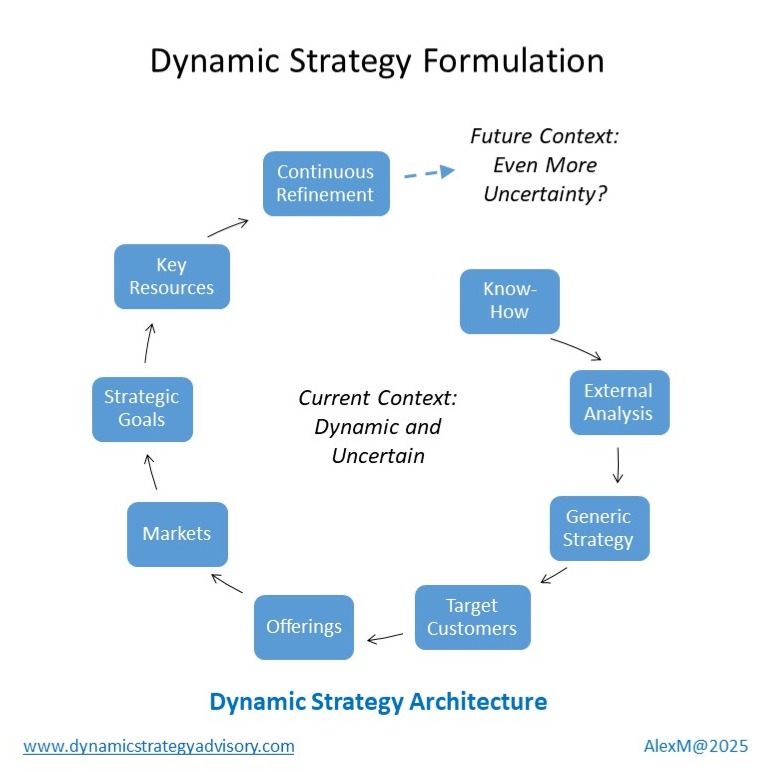
The evolving nature of the Dynamic Strategy Formulation Methodology is visually represented in Figure 1, which depicts its nine steps as a spiral. This spiral symbolizes the methodology’s adaptability, illustrating how strategies evolve through time and continuously adjust to changing contexts, ensuring relevance and effectiveness in a dynamic environment.
1. Know-How
The objective of the first step is to define the organization’s core strengths and unique expertise, ensuring that all strategic choices build upon a solid foundation of sustainable competitive advantage and value creation. This turns into the following key questions that must be asked during the process: What is our know-how, and do we possess any competitive advantages? Are they sustainable? How can we create value for both our customers and ourselves, including innovative value?
This step aligns closely with VRIO Analysis, which evaluates resources and capabilities based on their Value, Rarity, Imitability, and Organizational support. It also directly corresponds to the ‘Required Capabilities’ stage of the Playing to Win Strategy Cascade, as both focus on identifying and analyzing an organization’s strengths. While the ‘Winning Aspiration’ and ‘How to Win’ stages of the Cascade are indirectly linked, they rely on leveraging know-how to define the organization’s purpose and strategic positioning.
In the following example, the question ‘What is their know-how?’ reveals that Apple’s know-how lies in its design and innovation capabilities, specifically its ability to seamlessly integrate hardware and software. Do they possess competitive advantages? Yes, this integration, combined with user-centric design, creates a unique ecosystem. Are these advantages sustainable? Apple continually invests in R&D focusing on proprietary chips and supply chain control, and cultivates a strong brand image, making their advantages difficult to imitate. The question “How can they create innovative value?“ is reflected in its expansion into services such as the App Store, iCloud, and Apple Pay – leveraging existing expertise into new, high-margin opportunities. This systematic questioning reveals how Apple’s core competencies translate into tangible market success. This highlights how strategically asking these questions leads to identifying and leveraging core strengths, rather than simply stating them.
2. External Analysis
The objective of the second step is to assess external forces that influence the organization’s success, identify emerging opportunities, and potential threats to align the strategy with broader market dynamics and uncover new market spaces by recognizing non-customers and latent demand. This brings us to the key questions we need to ask along the way: What external opportunities and threats should we consider to align our strategy with the broader market dynamics? Can we uncover new market spaces among non-customers and latent demand?
This step corresponds with Porter’s Five Forces, which examines industry dynamics and helps organizations evaluate competitive pressures and market attractiveness. It also resonates with Blue Ocean Strategy, which emphasizes identifying untapped market spaces and creating new demand. Additionally, it aligns with SWOT Analysis, which supports mapping external opportunities and threats in relation to internal strengths and weaknesses.
In this example, the core questions help a company anticipate shifts in the competitive landscape. What external opportunities and threats should we consider? Netflix identified the opportunity created by rising internet speeds, digital streaming technology, and shifting consumer preferences toward on-demand content while recognizing threats such as the decline of DVD rentals and intensifying competition. Can we uncover new market spaces? Netflix pioneered subscription-based streaming, tapping into latent demand for on-demand, personalized entertainment. It attracted a vast audience of “non-customers” dissatisfied with traditional television, creating a Blue Ocean by eliminating physical rentals and offering personalized recommendations. This structured analysis demonstrates how Netflix’s strategic pivot was driven by a deep understanding of external forces, allowing it to seize emerging trends and shape a new market.
3. Generic Strategy
The objective of the third step is to define the organization’s competitive approach to guide the organization’s resource allocation and market positioning, whether through low-cost leadership, differentiation, focus strategy, or an innovative alternative. Therefore, the process requires us to consider these key questions: What will our generic strategy be: low-cost leadership, differentiation, a focus strategy targeting specific market segments, or some innovative approach? Will we adopt an industry-wide or niche approach?
This step aligns directly with Porter’s Generic Strategies, a framework that offers a clear method for choosing competitive approaches. The alignment with Blue Ocean Strategy complements this by encouraging innovative positioning beyond traditional competitive boundaries. Finally, the Playing to Win Strategy Cascade aligns through its How to Win component, as both focus on defining the organization’s competitive advantage. Whether the approach is differentiation, cost leadership, or innovation, this decision shapes the foundation for competitive positioning.
By addressing the question ‘What will our generic strategy be?’ we discover that IKEA employs a cost leadership strategy. This is achieved by making stylish furniture accessible to a broad audience through flat-pack designs, standardized production, and an efficient global supply chain. Will we adopt an industry-wide or niche approach? IKEA competes industry-wide, targeting mass-market consumers with its broad range of products rather than a niche segment. This choice drives economies of scale and reinforces its cost advantage. The strategic questioning process clarifies how IKEA’s cost leadership is not just about low prices – it is a carefully structured approach that aligns design, logistics, and retail experience to create value for customers while maintaining profitability.
4. Target Customers
The objective of the fourth step is to identify customer segments and their specific needs to ensure alignment with the organization’s strategy, maximizing market impact and positioning. This leads to the formulation of the following key question: Which customer segments do we want to target, and what specific needs will we aim to fulfill?
This step directly aligns with the Value Proposition Canvas, which emphasizes understanding customer needs, segmenting customers, and delivering tailored solutions. It also corresponds with the Ansoff Matrix, which supports identifying growth opportunities in existing or new customer segments. Blue Ocean Strategy aligns with Target Customers by encouraging organizations to look beyond current customer bases and identify new or underserved segments. By addressing latent demand and exploring non-customers, the methodology supports the creation of innovative value propositions tailored to these emerging opportunities. Finally, there is some overlap with Where to Play in the Playing to Win Strategy Cascade, which includes customer segments but has a broader scope, encompassing market, geographic, and product category choices.
Answering ‘Which customer segments do we want to target?’ reveals that Tesla focuses on environmentally conscious, tech-savvy consumers seeking high-performance electric vehicles. This question pushes a company beyond analyzing basic demographics, requiring an analysis of psychographics and behavioral patterns. What specific needs will we aim to fulfill? Tesla identified a gap in the market – early EVs often compromised on performance, design, or range. By addressing these concerns with cutting-edge battery technology, sleek design, superior acceleration, autonomous driving features, and over-the-air software updates Tesla attracted not only sustainability-focused buyers but also performance enthusiasts. This structured approach to defining target customers allowed Tesla to position itself as more than just an EV company – it became a status symbol and a leader in automotive innovation.
5. Offerings
The objective of the fifth step is to define the products and services that effectively meet customer needs, ensuring customer satisfaction, value creation, and sustainable growth. It poses a key question: What products and services should we offer to meet those customer needs effectively?
This step aligns directly with the Value Proposition Canvas, emphasizing the alignment of products and services with customer needs through tailored solutions. It also aligns with VRIO Analysis, ensuring offerings leverage the organization’s unique capabilities, and with Blue Ocean Strategy, which focuses on crafting groundbreaking, innovative offerings to unlock new markets. Additionally, ‘Offerings’ corresponds with the product development dimension of the Ansoff Matrix, guiding the development of products or services for existing markets as a growth pathway. Finally, it aligns with the Playing to Win Strategy Cascade, linking the purpose of offerings to the company’s broader strategic goals (Winning Aspiration) and competitive positioning (How to Win).
The question ‘What products and services should we offer?’ would have guided Amazon to identify, as they ultimately did, that their customers prioritize convenience, speed, and a seamless shopping experience. Instead of offering just fast shipping, the company created Amazon Prime – a subscription that bundles free one-day delivery, exclusive content, and additional services. This question pushes a company to think beyond single products, and to consider the entire customer experience. How does this effectively meet customer needs? Prime solves multiple pain points: it eliminates delivery delays, provides access to entertainment, and offers shopping benefits, strengthening customer loyalty. By consistently adding value and anticipating evolving customer preferences, Amazon has transformed Prime from a simple delivery service into a comprehensive ecosystem that fosters deep customer loyalty and drives recurring revenue. This systematic questioning process ensures that offerings are thoughtfully designed to enhance customer satisfaction, build stronger relationships, and drive growth. It highlights how asking the right questions about offerings can lead to innovative and effective solutions.
6. Markets
The objective of the sixth step is to identify the most strategic locations and markets for operations and competition, ensuring optimal resource allocation and value capture. The question is: In which locations or markets do we want to operate and compete?
This step aligns with the Ansoff Matrix, which provides guidance on market development strategies. It also corresponds with Porter’s Five Forces, which aids in evaluating market attractiveness and understanding competitive dynamics. Additionally, it connects with the “Where to Play” dimension of the Playing to Win Strategy Cascade, offering a framework for selecting specific markets or geographies to compete in. Lastly, it resonates with Blue Ocean Strategy, which encourages the exploration of unconventional or untapped market spaces, fostering innovation in market entry strategies.
The core question of this step, ‘In which locations or markets do we want to operate?’ guided Starbucks in building its global presence by expanding into high-growth international markets while carefully adapting to local cultures. Instead of a one-size-fits-all approach, Starbucks tailors its store designs, marketing campaigns, and product offerings to regional preferences – introducing matcha lattes in Japan, dulce de leche frappuccinos in Latin America, and kaya toast sets in Singapore. How does this optimize market impact? By blending global brand identity with local relevance, Starbucks has strengthened customer loyalty and differentiated itself from competitors. This strategic questioning ensures that market selection is deliberate, aligned with the company’s capacity to deliver value across diverse regions, and positioned to maximize competitive advantage and sustainable growth.
7. Strategic Goals
The objective of the seventh step is to establish clear, measurable goals that provide direction, create accountability, and ensure progress toward strategic success. This transforms into the critical question that guides the process: What measurable strategic goals will guide our efforts and define success?
This step aligns with the Balanced Scorecard, which translates strategic goals into actionable metrics across multiple perspectives. It also aligns with the Playing to Win Strategy Cascade, emphasizing the definition of aspirations and their linkage to measurable outcomes.
Unilever provides an example of a company successfully answering ‘What measurable strategic goals will guide our efforts?’ The company has embedded sustainability at the heart of its strategy, setting ambitious targets such as halving its environmental footprint and sourcing 100% of its agricultural raw materials sustainably by 2030. This question compels companies to move beyond vague aspirations and define specific, quantifiable targets. How does this drive strategic success? By setting clear sustainability metrics, Unilever aligns its environmental commitment with cost efficiency, product innovation, and stakeholder expectations. These goals also fuel innovation in sustainable practices – developing concentrated detergents to reduce packaging waste and investing in renewable energy to power operations. By defining and pursuing measurable goals, Unilever has strengthened its reputation, attracted environmentally conscious consumers, and achieved cost savings through resource efficiency. This structured approach transforms sustainability from a corporate statement into a measurable driver of competitive advantage, demonstrating how well-defined goals create focus, accountability, and long-term impact.
8. Key Resources
The objective of the eighth step is to identify, align and allocate efficiently the necessary assets, human resources, knowledge, and technology to successfully execute the strategy. This results in the following key questions we should explore during the process: What assets, human resources, knowledge, and technology are required to achieve this strategy? What resources need to be resized, relocated, or otherwise adjusted to align with our goals?
This step finds direct alignment with the Playing to Win Strategy Cascade, specifically its ‘Required Capabilities’ component. This dimension emphasizes the development and alignment of the right capabilities in place, ensuring the organization can deliver on its strategic decisions by securing critical assets, skills, and technologies. Furthermore, this step also aligns with the VRIO Framework, which assesses resources against their Value, Rarity, Imitability, and Organizational support to ascertain their potential for creating a lasting competitive advantage.
The core questions of this step guided Intel in strategically allocating and developing its resources. What assets, human resources, knowledge, and technology are required? In early 2022, Intel, recognizing the strategic importance of semiconductor production, committed $20 billion to building two advanced fabrication plants in Ohio. This decision, made amid global supply chain disruptions and geopolitical uncertainties, aimed to reposition Intel’s resource base to enhance control over its value chain, reduce geopolitical risks, and meet the anticipated rising demand for domestically produced semiconductors. What resources need to be resized, relocated, or otherwise adjusted? Beyond expanding manufacturing capacity, Intel needed to secure skilled talent, invest in cutting-edge chip-making technology available at the time, and strengthen supply chain resilience. The company sought to align its resources with long-term strategic priorities to reinforce its market position, sustain innovation, and support national technological leadership. This systematic questioning ensures that resource allocation is directly aligned with strategic goals, enabling efficient execution and sustainable growth. However, evolving market dynamics and rapid advancements in AI chip technology have reshaped the industry’s competitive landscape since Intel’s move, with Nvidia emerging as the leader by early 2025.
9. Continuous Refinement
The objective of the ninth and final step is to establish a process for ongoing monitoring, evaluation, and adaptation of the strategy, ensuring continued relevance and responsiveness to evolving market dynamics. This leads to the following key question that must be asked: How will we monitor, evaluate, and refine our strategy over time to address declining relevance and pivot toward new opportunities?
This step aligns with Blue Ocean Strategy, which emphasizes reassessing assumptions and uncovering new value creation opportunities – whether by identifying untapped markets or redefining existing ones in response to shifting strategic conditions. It also aligns with SWOT Analysis, which facilitates continuous evaluation of internal and external factors to refine strategic direction.
IBM is an example of a company that has successfully used such questions to continuously monitor its operating environment and adapt its strategy accordingly. How will we monitor, evaluate, and refine our strategy over time? IBM implemented a system for tracking market trends, customer feedback, and technological advancements to identify emerging opportunities and potential threats. Once a dominant player in hardware manufacturing, IBM recognized the declining relevance of its legacy business amid shifting industry dynamics. How did IBM pivot toward new opportunities? IBM strategically divested its hardware business and invested heavily in cloud computing and AI, acquiring companies with relevant expertise and developing new service offerings. This iterative approach to strategy refinement allowed IBM to reinvent itself and remain competitive in a rapidly changing technology landscape. This systematic questioning ensures that strategy remains dynamic and adaptable, allowing organizations to respond to shifting circumstances and seize emerging opportunities.
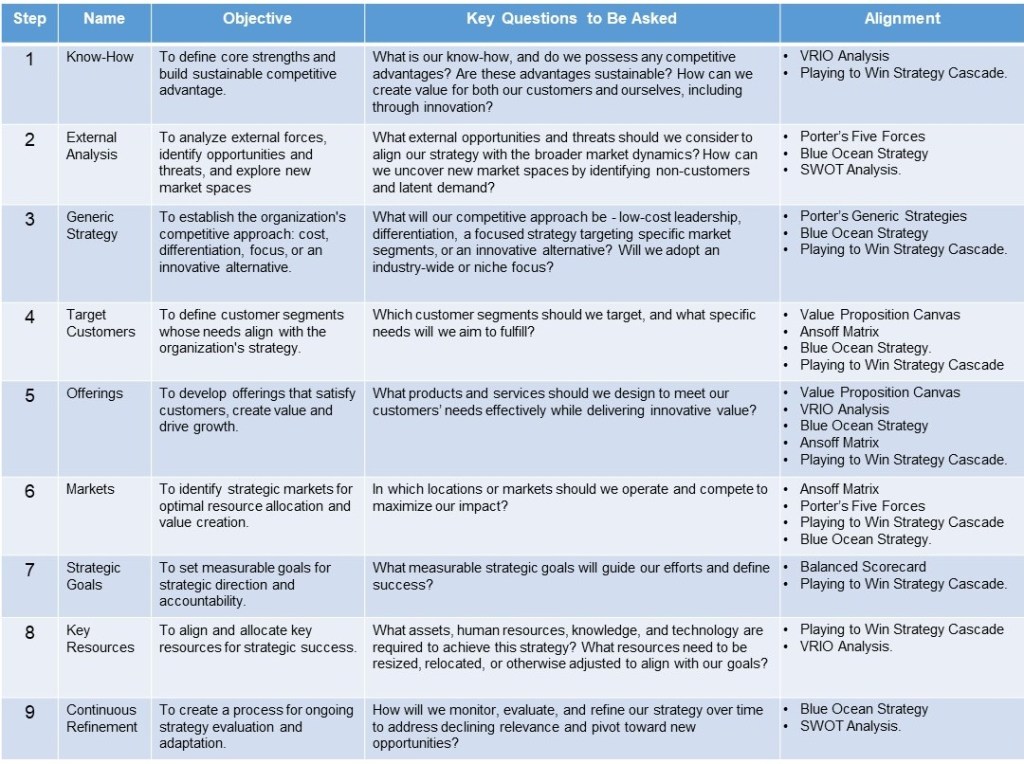
With the nine steps of the Dynamic Strategy Formulation Methodology now outlined, the next chapter explores the key advantages of this methodology, showing how it helps strategists move beyond isolated frameworks and equips them with a powerful tool to navigate today’s complex and uncertain business environment. For a concise overview of each step, including its objective, key questions, and framework alignment, please refer to Table 1.
A Strategist’s Toolkit: An Integrated and Actionable Approach
The Dynamic Strategy Methodology offers a structured yet flexible framework that integrates key strategy models into a practical, cohesive, end-to-end process. Unlike models that focus solely on competition (Porter’s Five Forces) or resource allocation (VRIO), this methodology ensures comprehensive coverage of all critical aspects of strategy formulation, presented in a logical and sequential manner.
A key advantage of this methodology lies in its dynamic nature. It is not a static blueprint but a living framework, enabling strategists to revisit and refine steps based on new insights, evolving market conditions, or execution challenges. This methodology guides strategists through a clear progression of questions that drive concrete choices rather than abstract analysis. Furthermore, the questions are designed to stimulate creative thinking, encouraging innovation and the development of unique value propositions.
Organizations often struggle to bridge the gap between strategy formulation and execution. This methodology actively addresses this challenge by compelling organizations to consider alignment – not just as an abstract concept, but in terms of identifying and aligning key resources, establishing measurable strategic goals, and implementing a process for continuous refinement. This ensures that strategy translates seamlessly into action, driving tangible results.
Conclusion
In an era defined by rapid change and unprecedented uncertainty, the ability to formulate dynamic and adaptable strategies is paramount. This article introduced the Dynamic Strategy Formulation Methodology, a structured, nine-step approach designed to bridge the gap between strategic theory and practical application. By integrating key insights from established frameworks into a cohesive, end-to-end process, this methodology empowers organizations to move beyond isolated strategic elements and develop strategies that are both responsive and innovative.
The methodology’s emphasis on continuous refinement and its focus on actionable questions provides strategists with a practical toolkit for navigating complex market dynamics. By offering a systematic approach to strategy formulation, this methodology aims to enhance strategic agility and drive sustainable growth.
Looking ahead, the next frontier lies in further testing and refining this methodology across different industries and organizational contexts. However, the most transformative opportunity may be exploring the role of artificial intelligence in enhancing each step of the process. Can AI streamline and optimize strategic formulation to the point where the human role is limited to making critical choices? Or could AI eventually take over the process entirely, reducing the human role even further? While this evolution holds promise, it also raises critical questions about risks, oversight, and the potential loss of human intuition in strategic thinking.
Ultimately, this methodology represents not just a solution for today’s challenges but also a foundation for navigating tomorrow’s uncertainties. As businesses continue to evolve, so too must the tools and approaches they rely on to shape their future.
REFERENCES:
ANSOFF, H. I. (1957). Strategies for Diversification. Harvard Business Review, 35(5), 113–124.
BARNEY, J. B. (1991). Firm Resources and Sustained Competitive Advantage. Journal of Management, 17(1), 99–120.
HENDERSON, B. (1970). The Product Portfolio. Boston Consulting Group Perspectives, 66.
KAPLAN, R. S., & NORTON, D. P. (1992). The Balanced Scorecard – Measures That Drive Performance. Harvard Business Review, 70(1), 71–79.
KIM, W. C., & MAUBORGNE, R. (2005). Blue Ocean Strategy: How to Create Uncontested Market Space and Make the Competition Irrelevant. Harvard Business Review Press.
LAFLEY, A. G., & MARTIN, R. (2013). Playing to Win: How Strategy Really Works. Harvard Business Review Press.
LEARNED, E. P. et al (1965). Business Policy: Text and Cases. Irwin.
MILOVANOVICH, A (2024). Strategic Management in the 21st Century. Self-published.
OSTERWALDER, A. et al (2014). Value Proposition Design: How to Create Products and Services Customers Want. Wiley.
PORTER, M. E. (1979). How competitive forces shape strategy. Harvard Business Review, 57(2), 137-145. PORTER, M. E. (1980). Competitive Strategy: Techniques for Analyzing Industries and Competitors. Free Press.
